Scored on rubric v0.9, October 2026
Verdict
The only vendor here with a real starting list price, and the deepest federal framework list. Vendor risk, audit path and pricing transparency are its weakest criteria, at 2 of 5 each.
Best for federal and defense frameworks.
Strengths
- The only starting list price in the set
- Custom tests on the base plan
- Deep federal coverage
Limitations
- Vendor risk depth sits on the Complete plan
- Higher plans show no price
Full review · 8 min read The full Secureframe review What you get · Plans and pricing · Frameworks · Evidence collection and monitoring · Audits · Vendor risk
Secureframe carries the deepest federal framework list in this set and the only starting list price. It scores 75 out of 100 on our rubric and ranks fourth in our SOC 2 compliance software ranking, behind Sprinto at 84, Vanta at 82 and Drata at 76.
The gaps show up as a company grows. Vendor risk earns the least credit, followed by the audit path and pricing transparency, and the advanced modules sit on plans with no list price.
What you get
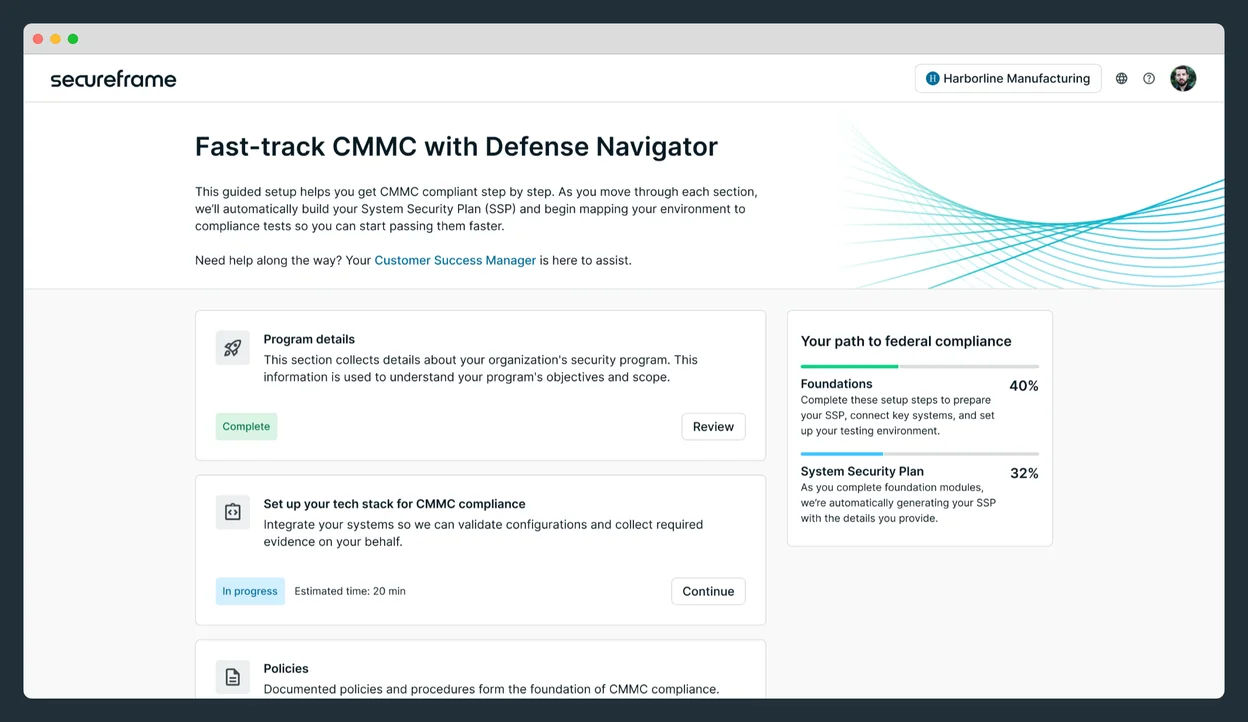
Secureframe sells three products. Comply is the core compliance platform. Trust is the trust center. Defense is a separate line for defense contractors working toward CMMC.
Comply handles the work most buyers come for. You connect your cloud, identity and HR tools. Secureframe then collects evidence against the controls in your framework and flags the tests that fail. A set of AI features runs across the product: Secureframe markets AI help for remediation, risk, policies, vendor reviews and control mapping, plus AI answers for security questionnaires.
Secureframe was founded in 2020 in San Francisco, has raised $79 million and has more than 200 employees. It says more than 6,000 customers use the platform.
Plans and pricing
| Plan | Price | What it adds |
|---|---|---|
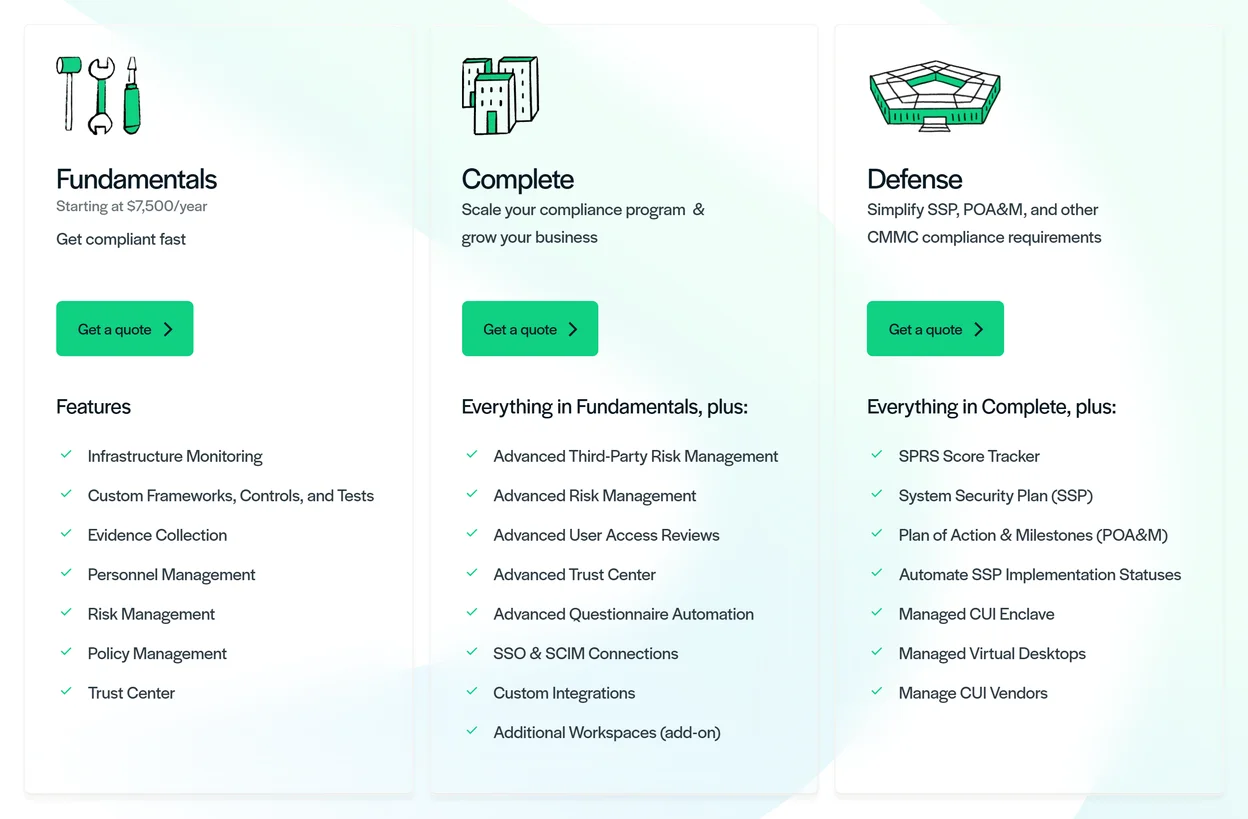
| Fundamentals | From $7,500 a year | Infrastructure monitoring, evidence collection, risk management, policy management, a trust center, custom frameworks and controls with one custom automated test, security awareness training and access to the Audit Partner Network |
| Complete | Quote only | Everything in Fundamentals, plus advanced versions of third-party risk, risk management, user access reviews, trust center and questionnaire automation, SSO and SCIM, custom integrations and unlimited custom tests. Extra workspaces cost more. |
| Defense | Quote only | Everything in Complete plus CMMC tooling: SPRS score tracking, SSP and POA&M automation, a managed CUI enclave and managed virtual desktops |
Prices are US figures as of October 2026. Both Fundamentals and Complete list one compliance framework. On AWS Marketplace, Secureframe lists the platform at $7,500 a year for up to 100 employees and a first framework at another $7,500, so $15,000 for platform plus one framework. If you need SOC 2 and ISO 27001 in the same year, get the price of each extra framework in writing before you sign.
The marketplace listings use different headcount bands, so compare them with care. Secureframe’s $15,000 covers up to 100 employees. Vanta’s entry is $14,000 for 1 to 20 employees, and Scrut’s is $15,000 for up to 20. Drata’s lowest listing is also $15,000, for 1 to 50 employees. Its separate listing for a 100-person organization costs $25,000 for the platform plus $7,500 per framework, for $32,500 with one framework. Our compliance software pricing study has every listing side by side.
 Thoropass $8,700 No band listed
 Sprinto $9,500 Up to 100 employees
 Vanta $14,000 1 to 20 employees
 Secureframe $15,000 Up to 100 employees
 Scrut $15,000 Up to 20 employees
 Drata $15,000 1 to 50 FTE
Frameworks
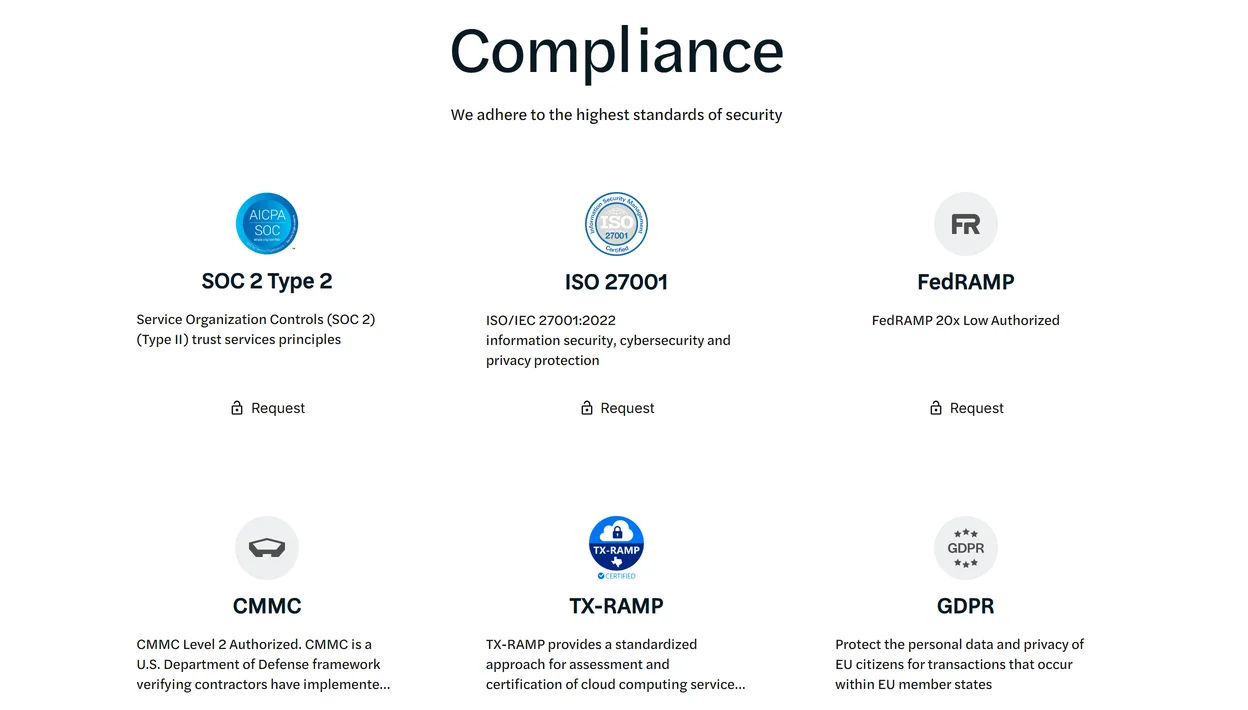
Secureframe covers more than 30 named frameworks in five groups: commercial, federal, data privacy, AI and a catch-all. It scores full marks on framework coverage in our rubric.
The federal list is where it pulls ahead. It includes CMMC 2.0, NIST 800-53 at low, moderate and high, NIST 800-171, NIST CSF 2.0, FedRAMP, GovRAMP, CJIS and TX-RAMP. For AI governance it covers NIST AI RMF, ISO 42001 and the EU AI Act. You can also build custom frameworks for internal or customer-specific requirements.
Secureframe has been through the same federal reviews it helps customers pass. It earned its own CMMC Level 2 certification in September 2025. The platform is FedRAMP Certified at Class C (Moderate) through the 20x program, audited by Coalfire Federal, and was among the first 20x authorizations in August 2025. Secureframe also lists more than 25 CMMC Registered Practitioners. For a defense supplier choosing a CMMC vendor, that matters more than any feature list.
Scrut names more frameworks in total (70+), including regional sets such as MAS TRM, SAMA and RBI, but FedRAMP is not among them.
Evidence collection and monitoring
Secureframe claims more than 300 integrations, including AWS, Google Cloud and Azure. Tests run daily, and admins get an email when a test fails or changes status. A test library holds hundreds of prebuilt tests next to the ones you write yourself.
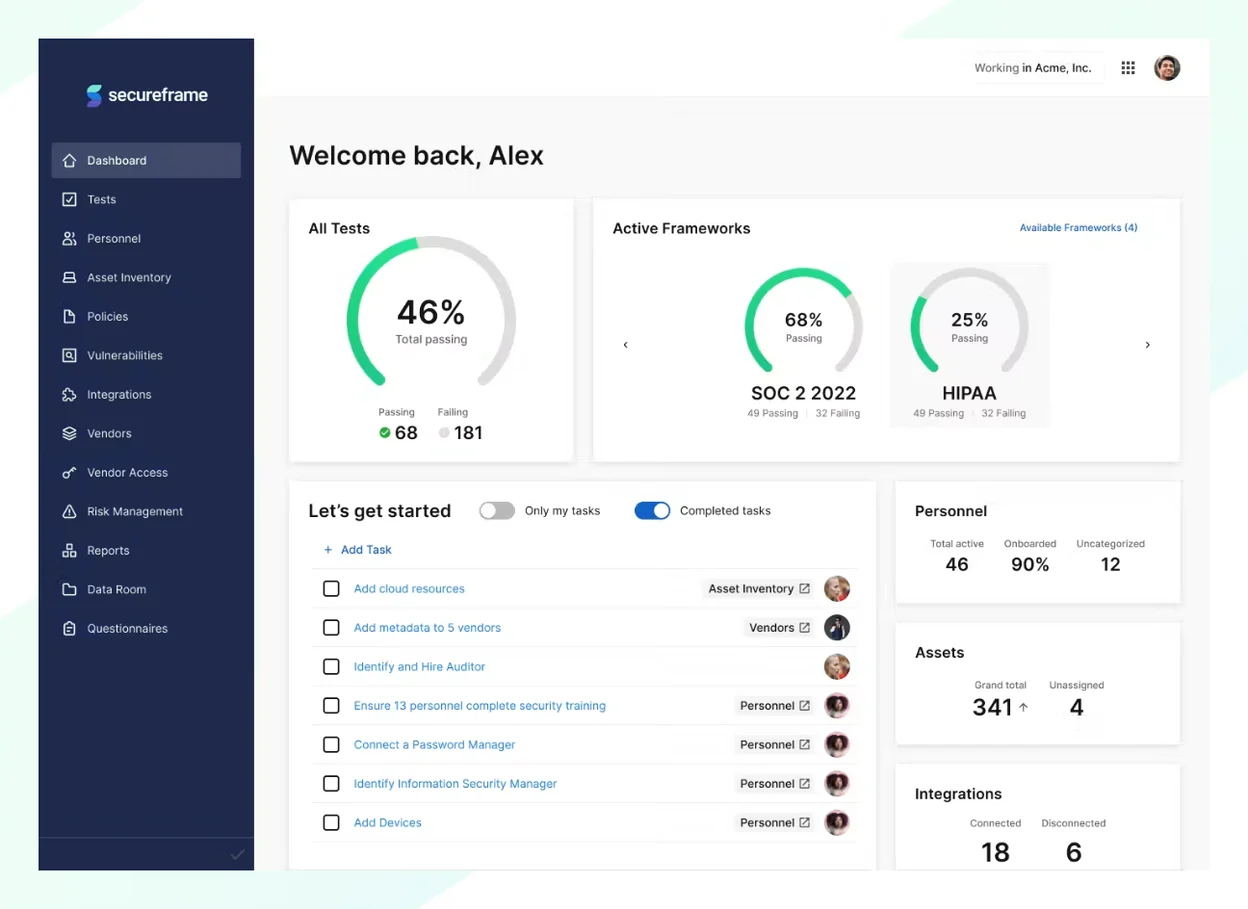
Vulnerability data comes in from your connected tools with no agent to install. Evidence can be downloaded in bulk, including the raw JSON behind a failed test, which helps when an engineer needs to see exactly what broke. An API covers anything the prebuilt integrations miss.
Fundamentals includes one custom automated test and Complete removes the limit. A plan that depends on dozens of custom checks needs Complete, or a look at Drata, which is built for teams that write their own.
Audits
Both plans include access to the Secureframe Audit Partner Network, a group of audit firms that work with Secureframe and its customers. You still hire and pay the auditor separately. Our score credits the partner network and gives no credit for auditor review inside the platform, which is why its audit path scores 2 out of 5.
Buyers who want the audit and the platform from one company should look at Thoropass, which delivers audits in its own platform. If you are still working out who can sign off on a SOC 2 report, start with who performs a SOC 2 audit.
Vendor risk
Secureframe’s vendor risk features include a vendor dashboard with profiles, risk assessments, documents and history. It flags shadow IT by spotting apps employees reach through SSO that are missing from your vendor list. An AI feature pulls answers out of vendor documents such as SOC 2 reports and suggests them for your review.
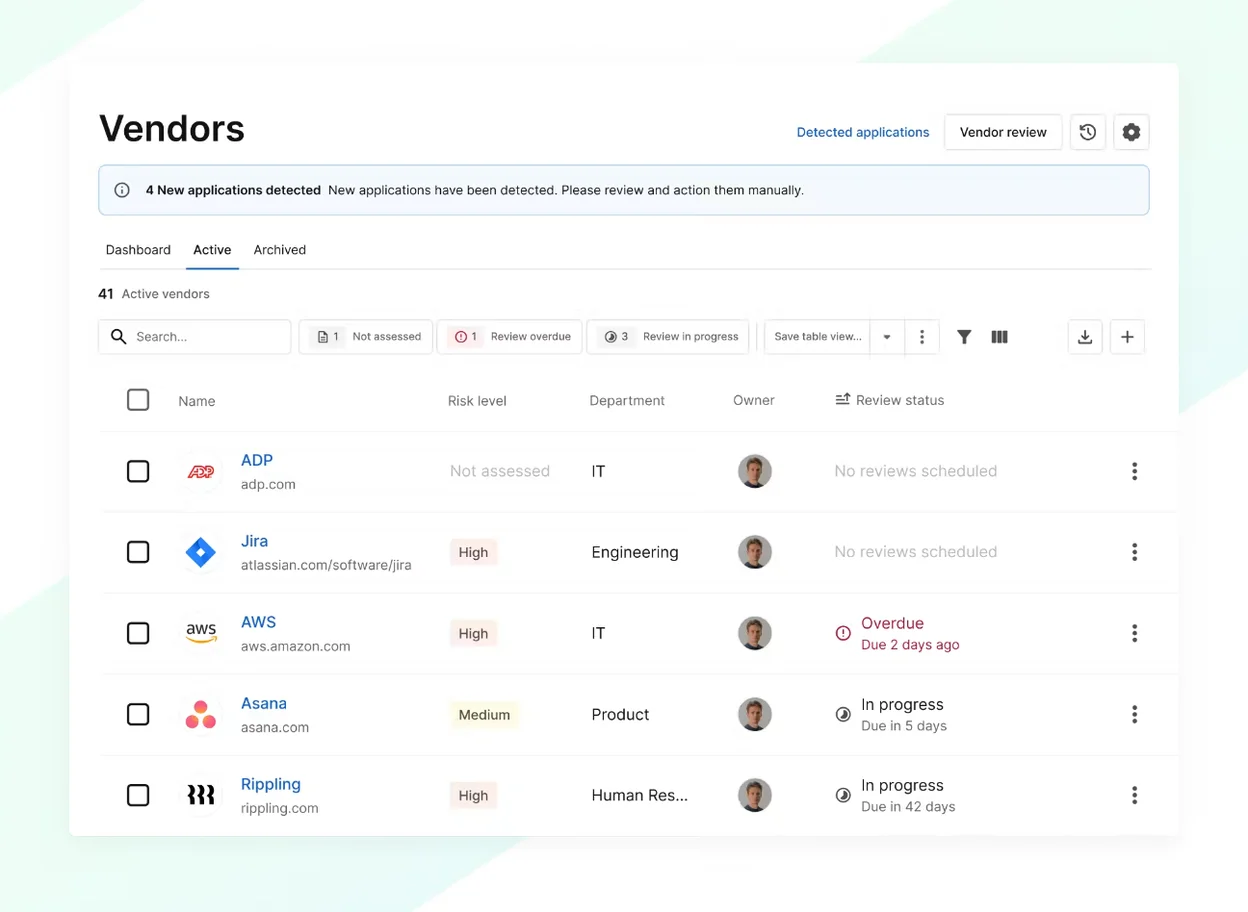
The advanced third-party risk module sits on the Complete plan. Vendor risk is the lowest criterion on this scorecard at 2 out of 5: vendor profiles, risk assessments and custom risk scores earn credit, and questionnaires sent to vendors from the platform do not. If vendor reviews take up a large share of your security team’s week, Sprinto, Vanta and Scrut score 5 out of 5 here and Drata scores 4.
Trust center and security questionnaires
The trust center runs on your own domain with your logo, colors, fonts and custom CSS. Visitors can download public documents or request gated ones. Your admins approve or deny each request and can require an NDA first.
Questionnaire automation drafts answers from your Secureframe data and a knowledge base your subject experts keep current. Secureframe says customers save 35 hours a month on questionnaires on average. The advanced versions of both tools sit on Complete. This area scores 4 out of 5.
Policies and people
Policy templates are written and approved by former auditors. An AI editor can simplify the language or change the tone. When you add a framework, Secureframe drafts policy addendums so you extend the policies you have instead of starting over.
Personnel come in from your HR, SSO and device management tools. Each employee gets a task list: accept policies, finish security training, complete a background check. Checkr and Vetty connect for the background checks. Security awareness training is included on both plans.
Support and services
Secureframe says it has more than 30 in-house compliance experts and former auditors. It states its own support numbers: 97.5% customer satisfaction, a 49-minute median email response and a 30-second live chat response. G2 lists the average implementation time at 2 months.
What G2 reviewers say
Secureframe holds 4.7 out of 5 from 829 reviews on G2. 84% of reviews are five stars and 14% are four stars.
Ease of use and low SOC 2 upkeep lead the praise. Complaints are mostly about fit: niche integrations take manual setup, and reminder schedules are hard to adjust. A small-business reviewer on that fit problem: “it wants you to do things its way, even if your setup doesn’t quite match.”
Who should buy Secureframe
- Defense contractors and federal suppliers. CMMC, FedRAMP and NIST 800-171 sit in one platform, from a vendor that holds CMMC Level 2 itself. The Defense plan adds the SSP, POA&M and enclave work on top.
- Teams that want a number before the first sales call. $7,500 a year is a real starting point for a budget conversation.
- Small teams on a first SOC 2. Auditor-written policy templates, daily monitoring and an in-house expert team cover most of what a first audit needs.
Who should look elsewhere
- Vendor risk is central to your program. Sprinto, Vanta, Scrut and Drata all score higher on vendor risk, and Secureframe vs Vanta puts the 3-level gap against Vanta at 6 points of the total.
- You will write many custom tests. Drata is built for teams that do, and Sprinto scores highest on customisation.
- You want the audit included. Thoropass bundles the audit with the platform.
- You sell into regulated markets outside the US. Scrut covers more regional frameworks.
How we score it
Secureframe scores 75 out of 100 on rubric v0.9. It earns full marks on framework coverage, automated evidence and user sentiment. Three criteria cost it the most: vendor risk management (2 out of 5), audit path (2 out of 5) and pricing transparency (2 out of 5), since only the entry plan shows a price.
Score by criterion
- Framework coverage15% of total5/5
Around 33 named frameworks, including NIST 800-53 High, FedRAMP and CMMC 2.0, with a dedicated defense product line.
Level 5: All of level 3, plus three or more of ISO 42001, NIST CSF, NIST 800-53, FedRAMP or CMMC.
- Automated evidence20% of total5/5
300+ native integrations, continuous control monitoring with a test library, and API documentation.
Level 5: 300 or more integrations, continuous tests, and a public API or custom integration builder.
- Audit path15% of total2/5
Access to the Secureframe Audit Partner Network. No credit for auditor review inside the platform.
Level 2: A named partner network of audit firms, or auditors can review evidence inside the platform.
- Pricing transparency10% of total2/5
The Fundamentals plan starts at $7,500 a year. Higher plans show no price.
Level 2: A single starting price.
- Trust and questionnaires10% of total4/5
A trust center with a custom domain, and AI questionnaire automation.
Level 4: Both, with AI-assisted questionnaire answering.
- Vendor risk management10% of total2/5
A vendor tab with profiles, risk assessments, documents, history and custom risk scores, in the advanced third-party risk module on the Complete plan. No credit for questionnaires sent to vendors from the platform.
Level 2: Inventory plus risk ratings entered by hand.
- Customisation10% of total4/5
Custom frameworks, controls and tests on both plans. Fundamentals includes one custom automated test and Complete lifts the limit.
Level 4: Custom frameworks, plus custom automated tests.
- User sentiment10% of total5/5
4.7 out of 5 from 829 reviews on G2.
Level 5: Average 4.5 or higher with 200 or more reviews.
Not credited in this score
- Questionnaires sent to vendors from the platform
- Auditor review inside the platform
Secureframe can ask for a re-check of any of these. If the score changes, the change is logged.