Six compliance platforms rated on policy management, risk registers, auditor portals and access reviews. Sprinto leads at 84 out of 100, updated October 2026.
AT
The Audit Trail editorial desk
Updated Oct 11, 2026 · First published Oct 1, 2026
Compliance management software runs a compliance program day to day: the risk register, the policy library, access reviews, the auditor’s view of evidence and the tasks that tie each gap to a person. Of the six platforms rated here, Sprinto ranks first at 84 out of 100. It sells policy, risk and access management as named products, next to an audit module where auditors review evidence inside the platform.
Vanta is second at 82, with a risk register built on a library of more than 100 prebuilt risk scenarios and the largest published integration count of the six. Drata is third at 76. It keeps auditor work in one Audit Hub and names a network of more than 175 audit firms. Secureframe is fourth at 75 and runs user and vendor access reviews as separate tools. Scrut follows at 72 and Thoropass at 52.
Best for a risk register bundled with an in-house audit
52/100
Not published.
Delivered in-platform by Thoropass Assurance, a licensed CPA firm
4.7/5 (585 G2)
What compliance management software does
The Consumer Financial Protection Bureau’s examination manual opens a compliance management review with board and management oversight, then the compliance program itself. The software on this page runs that compliance program for security frameworks such as SOC 2, ISO 27001 and HIPAA.
A risk register holds the risks a company has identified and names an owner for each one. A policy library stores the policies a company has adopted and records who has accepted them. An auditor portal gives an outside reviewer a controlled view of evidence. Access reviews confirm, on a schedule, that people with system access still need it. Task ownership and reporting tie each control and each gap to a named person and a due date.
Underneath all of this sit the integrations and automated tests that pull evidence and check controls on their own, which is what compliance automation describes. Each of the six platforms here is built to run a program across one or more named frameworks. GRC adds governance and enterprise risk to compliance, and the GRC software ranking rates all seven scored platforms for that wider buyer.
How we ranked these
Every platform on this site is ranked on the same eight-criterion rubric, so the totals here match the SOC 2 compliance software ranking and every other list. The criteria run in priority order by weight: automated evidence (20 points), then framework coverage and audit path (15 each), then trust and questionnaires, vendor risk management, customisation, pricing transparency and user sentiment (10 each).
A stalled integration or a framework built by hand is the daily cost a compliance manager pays, and audit path measures how short the road is from ready to a signed report. Customisation asks whether a team can build a framework, a control or a test the vendor did not ship, and whether one test can count toward more than one framework. A capability counts when the vendor lists it on any plan or add-on.
1. Sprinto: Best for policy, risk and access tools as named products
84/100
Strong (70 to 84)
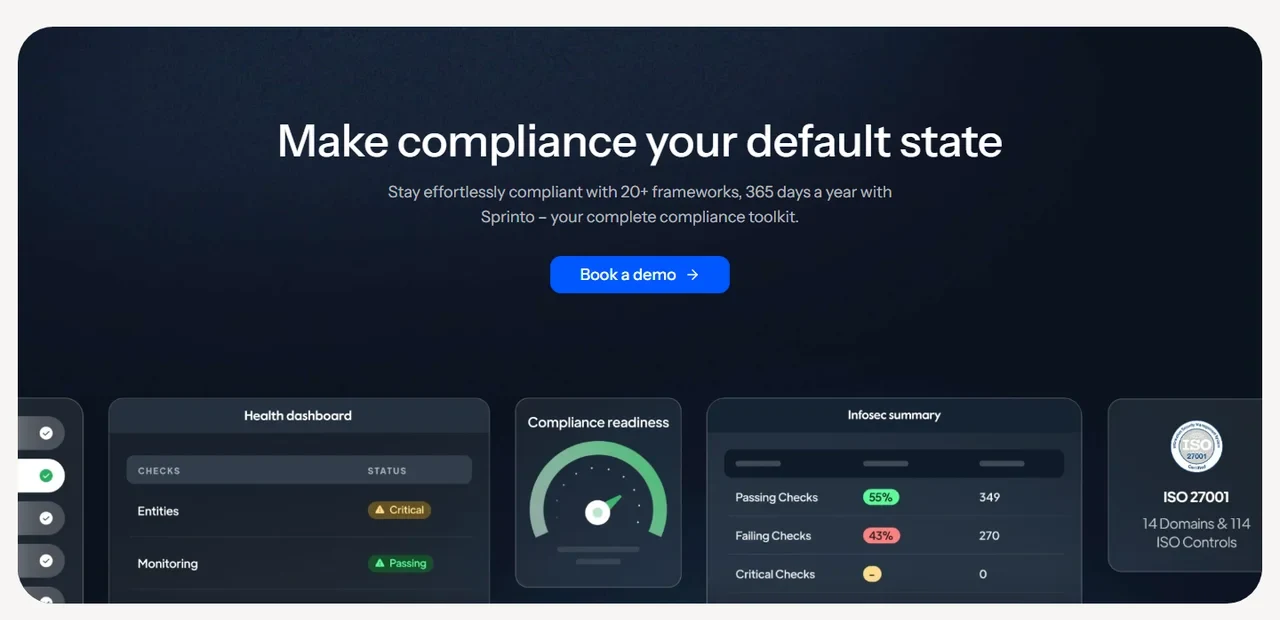
Sprinto product page, captured 24 September 2026
Sprinto ranks first at 84 out of 100. Policy Management, Risk Management and Access Management are each named products, so policy versions, the risk view and access rights reviews each get their own module. A named network of audit partners works alongside an audit management module where auditors review evidence inside the platform. Vendor risk covers automated discovery, AI review of vendor documents and periodic reviews, with continuous monitoring in an Enterprise TPRM add-on. Sprinto's unified control set maps one test across several frameworks, and custom frameworks extend what ships out of the box. That mix suits a team running its first program across more than one framework.
Best for
Best for policy, risk and access tools as named products
2. Vanta: Best for a risk register with a prebuilt scenario library
82/100
Strong (70 to 84)
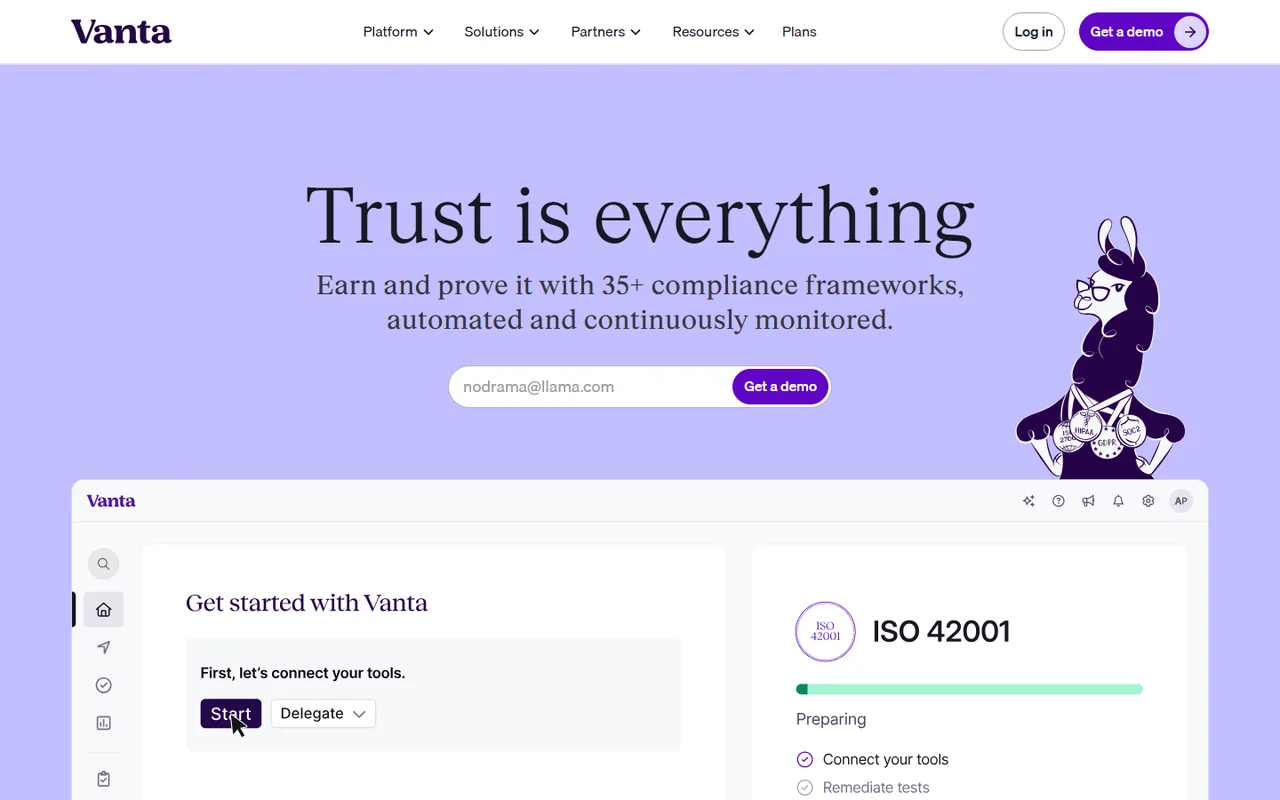
Vanta homepage, captured 24 September 2026
Vanta ranks second at 82 and covers all 10 frameworks in our matrix. Its risk register assigns an owner to each risk, scores inherent risk, records a treatment plan and scores residual risk. Vanta says the register comes with a prebuilt library of more than 100 common risk scenarios. Policy management ships with templates for every framework, a step-by-step policy builder and automated tracking of employee acceptance. Vendor risk covers automated discovery, AI-assisted security reviews of vendor documents and a TPRM Agent that monitors vendors continuously. Vanta claims more than 400 integrations, the largest published count of the six, which keeps more evidence collection automatic as a program grows.
Best for
Best for a risk register with a prebuilt scenario library
The largest integration catalog in the SOC 2 ranking, with 5 of 5 on vendor risk. Pricing transparency is its weakest criterion, since no price appears on its site. Its audit path scores 3 of 5.
3. Drata: Best for keeping auditor work in one Audit Hub
76/100
Strong (70 to 84)
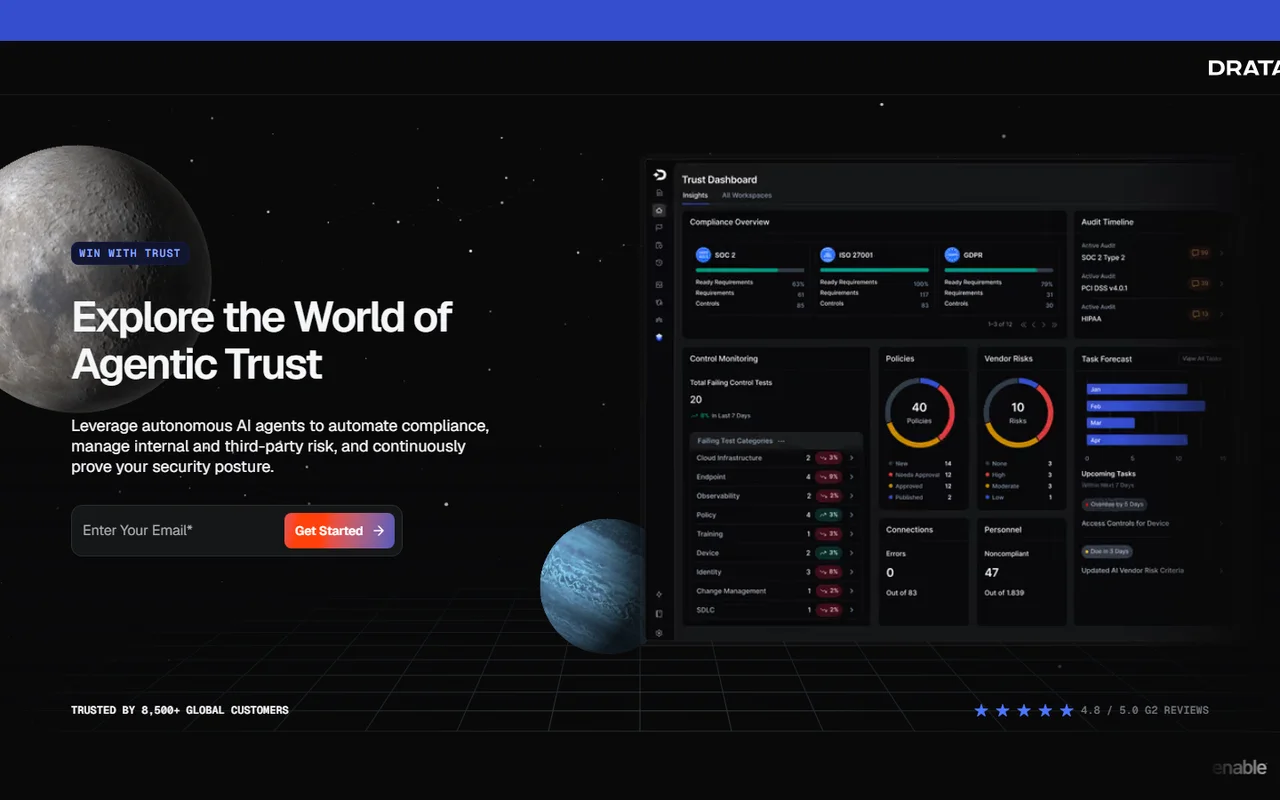
Drata homepage, captured 24 September 2026
Drata ranks third at 76. It sells Enterprise GRC and Compliance Automation as separate product lines. Its Audit Hub gives auditors one workspace for evidence requests and approvals, and Drata names a curated network of audit firms, the Auditor Alliance Program, which it says counts more than 175 firms. That pairing earns 3 out of 5 on audit path. Access reviews automate ownership, remediation tickets and access validation. No-code custom tests, called Adaptive Automation, let a team build controls without writing code. Third-party risk pulls documents from a vendor's trust center to run assessments. For a team that wants one place to run an audit with an outside firm, the Audit Hub is the core of the product.
Strong on custom automation, vendor risk and a named network of audit firms. Drata prints no price on its website and describes its integrations only as "hundreds", which holds its score down.
4. Secureframe: Best for separate user and vendor access reviews
75/100
Strong (70 to 84)
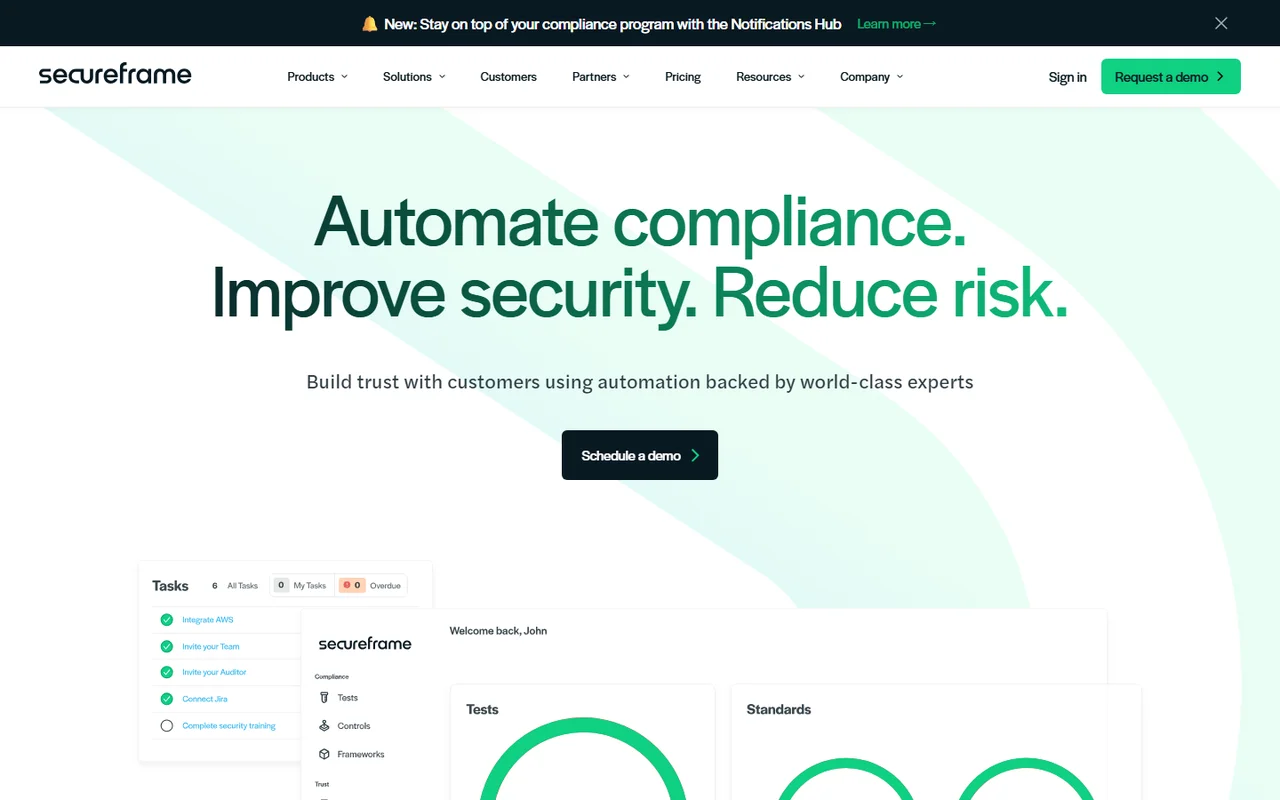
Secureframe homepage, captured 24 September 2026
Secureframe ranks fourth at 75. Its risk management follows the ISO 27005 methodology, with a library of NIST-based risk scenarios covering fraud, legal, finance and IT. Dashboards show risk through heat maps, summary tables and trend charts. User Access Reviews and Vendor Access Reviews run as two separate tools, so employee access and vendor access are reviewed apart. Secureframe says hundreds of automated tests run against connected systems. Custom frameworks, controls and tests come on the base plan. The advanced third-party risk module sits on the higher Complete tier.
5. Scrut: Best for automated access reviews across connected apps
72/100
Strong (70 to 84)
Scrut homepage, captured 24 September 2026
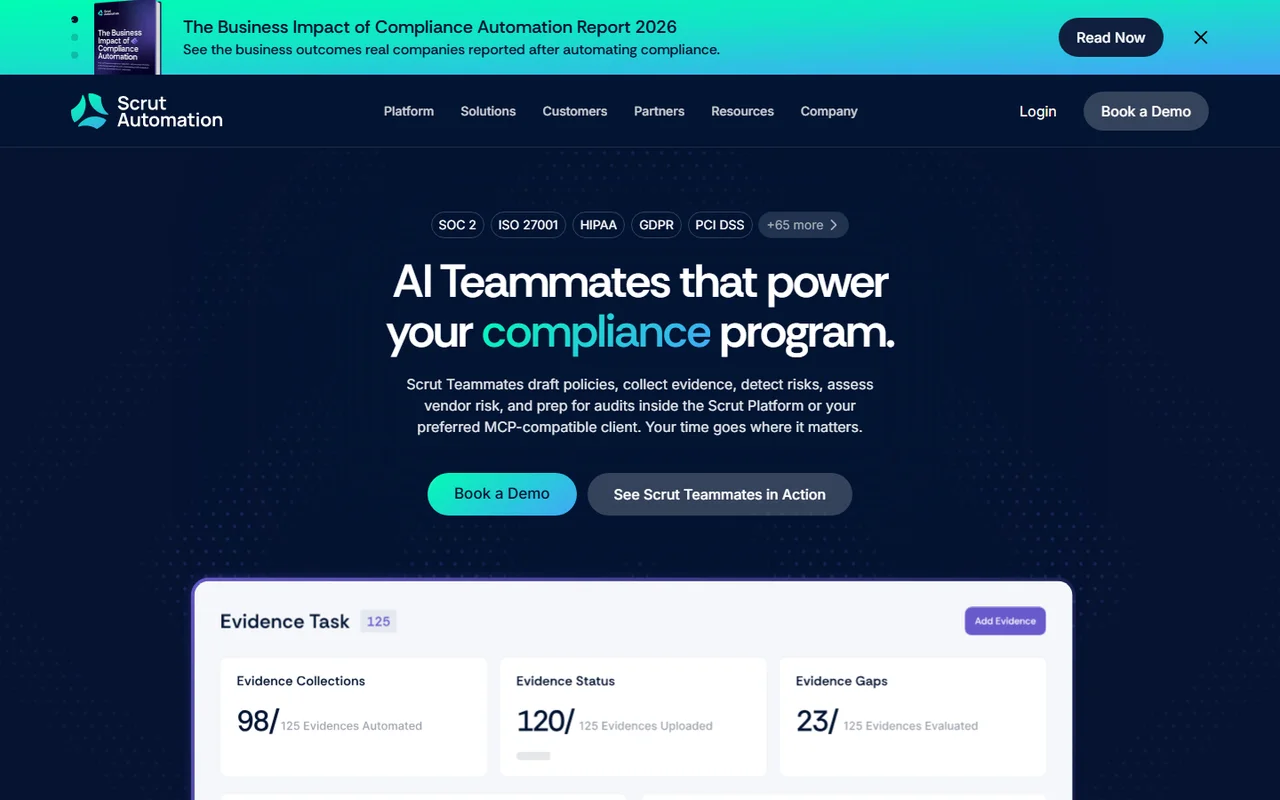
Scrut ranks fifth at 72 and calls its platform Intelligent GRC. A custom risk register maps each risk to controls, with structured treatment workflows. The Audit Center lets a team invite auditors, control what they see and share evidence. It also runs internal and external audits on the same framework separately. Access reviews pull user data from more than 100 connected apps, including Google Workspace and Azure AD, with reviewer and approver steps and scheduled recurring reviews. Scrut supports more than 70 frameworks out of the box. It holds the highest G2 average of the six, 4.9 from 1,328 reviews.
Best for
Best for automated access reviews across connected apps
Score
72/100
Pricing
Not published.
Audit
Partner-network auditors, with an Audit Center for evidence review
6. Thoropass: Best for a risk register bundled with an in-house audit
52/100
Limited (35 to 54)
Thoropass homepage, captured 24 September 2026
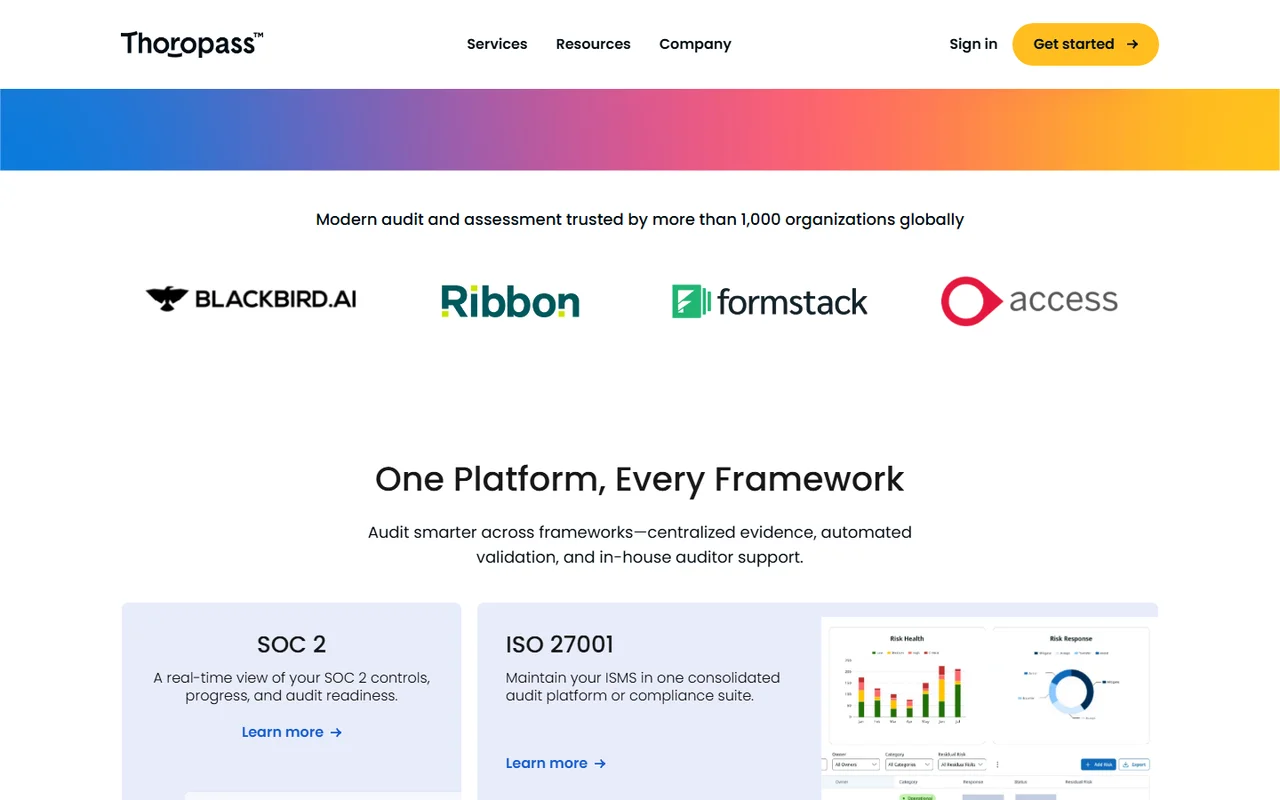
Thoropass ranks sixth at 52. It delivers the audit itself through its own CPA practice, Thoropass Assurance, and earns 5 out of 5 on audit path, the top mark among the six on that criterion. Its Risk Register gives what Thoropass calls a 360-degree view of a company's risks, with tracking, evaluation and remediation on a configurable 4x4 or 5x5 dashboard. Policy management runs inside the platform, and its trust center runs on a custom domain. Vendor risk, customisation and pricing transparency earn the least credit, at 0 out of 5 each. A team that wants one contract for the platform and the audit gets exactly that.
Best for
Best for a risk register bundled with an in-house audit
Score
52/100
Pricing
Not published.
Audit
Delivered in-platform by Thoropass Assurance, a licensed CPA firm
The only vendor that delivers the audit itself, through its own licensed CPA firm. It scores 0 of 5 on vendor risk, customisation and pricing transparency, and 1 of 5 on automated evidence.
The totals measure what each platform includes. They say less about how long setup takes or how responsive support is. A platform that scores well on customisation can still need engineering time to configure.
Policy template counts are hard to compare. Vanta, for example, says it has templates for every framework without giving a number. Prices are harder still: our pricing study found that five of the six print no dollar figure.
Some vendors publish productivity figures from research they paid for. Vanta cites an IDC paper sponsored by Vanta, which says its customers spend 82 percent less time per audit. Secureframe cites a survey it commissioned of more than 160 small businesses, which reports a 27 percent drop in compliance costs. Both figures describe each vendor’s customers, and neither changes a score.
A high total can also hide an uneven module. Thoropass earns full marks on audit path and 0 out of 5 on vendor risk, customisation and pricing transparency.
Who should buy which
Teams starting a first program across more than one framework:Sprinto maps one test across several frameworks and keeps policy versions in its own Policy Management product.
Teams that need a risk register the board will read:Vanta scores inherent and residual risk against a library of more than 100 scenarios. Thoropass shows risks on a configurable 4x4 or 5x5 dashboard.
Teams running audits with an outside firm:Drata keeps evidence requests and approvals in its Audit Hub and names its partner firms through the Auditor Alliance Program.
Teams with defense contracts:Secureframe sells a dedicated Defense plan for CMMC 2.0 and NIST 800-53 High, and it ranks 4th among the CMMC compliance software platforms.
Teams reviewing access across many connected apps:Scrut pulls user data from more than 100 integrated apps, including Google Workspace and Azure AD, and schedules recurring reviews.
Teams that review employee access and vendor access on different tracks: Secureframe runs User Access Reviews and Vendor Access Reviews as two tools.
Teams that want the audit and the platform from one vendor: Thoropass delivers the audit through its own CPA practice and includes a risk register.
Best for a risk register bundled with an in-house audit
52/100
Not published.
Delivered in-platform by Thoropass Assurance, a licensed CPA firm
4.7/5 (585 G2)
Conclusion
For running a compliance program day to day, Sprinto leads at 84 out of 100. Its policy, risk and access tools are named products, its control set maps one test across frameworks, and auditors review evidence inside the platform. Vanta (82) brings a prebuilt library of more than 100 risk scenarios and the largest published integration count. Drata (76) suits teams that run audits with an outside firm through its Audit Hub.
A vendor that disagrees with a score can send evidence for a recheck, and every change is logged in the rubric changelog.
Sprinto ranks first at 84 out of 100. Policy Management, Risk Management and Access Management are named products, next to an audit partner network and an audit management module. Vanta is second at 82, with a risk register built on a library of more than 100 risk scenarios. Drata is third at 76 and Secureframe fourth at 75.
How does compliance management software differ from GRC software?
GRC is the wider term. Gartner defines GRC tools as supporting an "enterprise risk management (ERM) process," and ISACA's glossary calls GRC "a business term used to group the three closely related disciplines responsible for operations and the protection of assets." Gartner also describes a narrower category, Corporate Compliance and Oversight, built around standardizing and automating compliance activities. Compliance management software sits in that narrower layer and is organized around one or more named frameworks.
Is compliance management software the same as compliance automation?
The two overlap. Compliance management software is the organizing layer: a risk register, a policy library, an auditor portal and task ownership across one or more frameworks. Compliance automation is the mechanism inside it, the integrations and automated tests that collect evidence and monitor controls on a schedule. All six platforms on this page sell both in one subscription.
Does compliance management software replace a compliance audit?
For five of the six platforms here, a licensed CPA firm issues the audit opinion. Thoropass is the exception: it delivers the audit itself, through its own CPA practice, Thoropass Assurance. The other five connect a buyer to an outside firm through a partner network or let the buyer bring its own auditor.
Which of these platforms has the strongest auditor portal?
Thoropass scores highest on audit path, at 5 out of 5, because it delivers the audit itself. Sprinto, Vanta, Drata and Scrut share the next highest mark, 3 out of 5: each names a partner network of audit firms and lets auditors review evidence inside the platform. Drata's Audit Hub and Scrut's Audit Center both give auditors a workspace for evidence.