Scored on rubric v0.9, October 2026
Verdict
Strong on custom automation, vendor risk and a named network of audit firms. Drata has no list price and describes its integrations only as "hundreds", which holds its score down.
Best for teams that will build custom tests.
Strengths
- No-code custom tests
- Automated review of vendor documents
- Public API and custom connections
Limitations
- No integration count
- Custom frameworks are a paid add-on
Full review · 8 min read The full Drata review What you get · Plans and pricing · Frameworks · Evidence collection and monitoring · Audits · Vendor risk
Drata lets a team write its own no-code tests and brings auditors into a shared workspace. It scores 76 out of 100 on our rubric and ranks third alone in our SOC 2 compliance software ranking, behind Sprinto at 84 and Vanta at 82 and ahead of Secureframe at 75.
The Auditor Alliance gives it a named network of more than 175 audit firms with evidence review inside the platform, and Adaptive Automation lets a team build its own no-code tests instead of waiting on Drata’s library. Pricing transparency scores lowest, at 1 out of 5: Drata lists plan names and nothing else, and its integration catalog stops at the word “hundreds.”
What you get
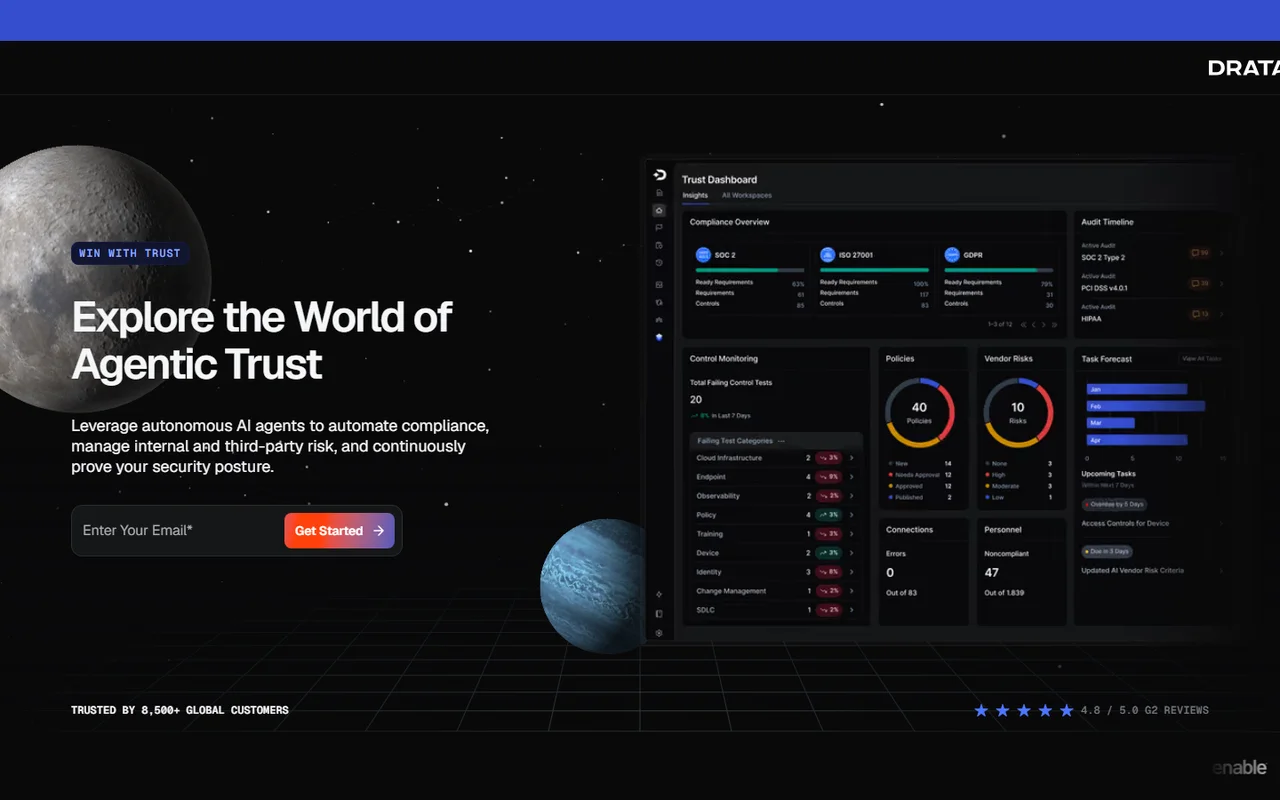
Drata calls itself an agentic trust management platform. Its own words: “Leverage autonomous AI agents to automate compliance, manage internal and third-party risk, and continuously prove your security posture.” Under that label sit two platform tracks. Compliance Automation and Enterprise GRC collect evidence and run control tests, and Enterprise GRC adds a governance layer for larger companies. Trust Center and AI Questionnaire Assistance form the second track, built to prove a certification once it exists. Third-Party Risk Management is now sold on its own.
Drata was founded in 2020. It raised a $200 million Series C in December 2022 at a $2 billion valuation and says it serves more than 8,500 customers worldwide.
Plans and pricing
| Plan | Price | What it adds |
|---|---|---|
| GRC Platform Foundation | Quote only | Up to 50 FTEs, one pre-mapped framework, risk management, custom controls, open API |
| GRC Platform Advanced | Quote only | Any framework, custom connections and tests, custom frameworks as an add-on |
| GRC Platform Enterprise | Quote only | Risk Management Pro, Compliance as Code Pro, user access review |
| Assurance Platform Foundation | Quote only | Branded trust center, up to 100 approved domains, 10 questionnaires a year |
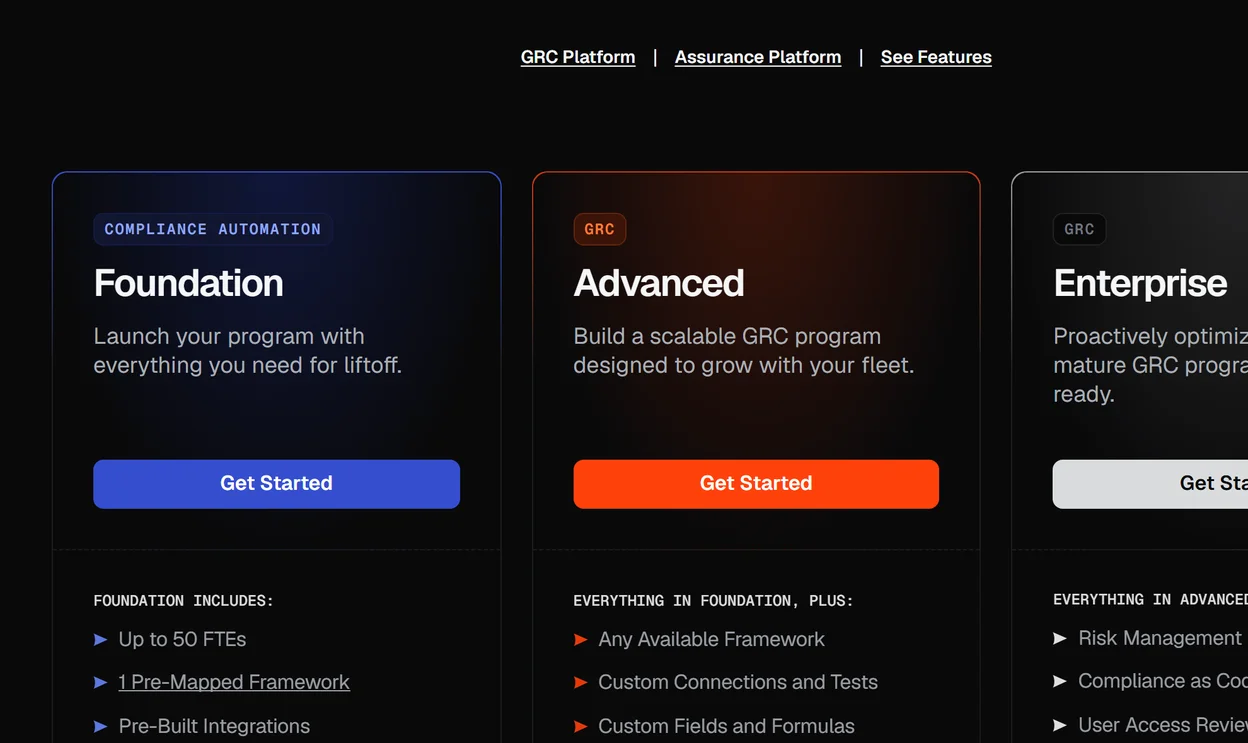
Prices are in US dollars. Drata’s plans page names tiers and features with no dollar sign anywhere. Custom frameworks sit on the Advanced and Enterprise add-on list, not inside either plan by default.
On AWS Marketplace, Drata’s two listings disagree. One lists a $25,000 platform fee for a 100-employee organization plus $7,500 for each extra framework, from SOC 2 to CMMC. The other lists a flat $15,000 Foundation Package for 1 to 50 employees, with no separate tiers. Check which headcount band applies before picking a number. Our compliance software pricing study lines up every vendor’s lowest listed figure, and marketplace numbers never earn pricing transparency credit, since that score counts only a vendor’s list prices.
 Thoropass $8,700 No band listed
 Sprinto $9,500 Up to 100 employees
 Vanta $14,000 1 to 20 employees
 Secureframe $15,000 Up to 100 employees
 Scrut $15,000 Up to 20 employees
 Drata $15,000 1 to 50 FTE
Frameworks
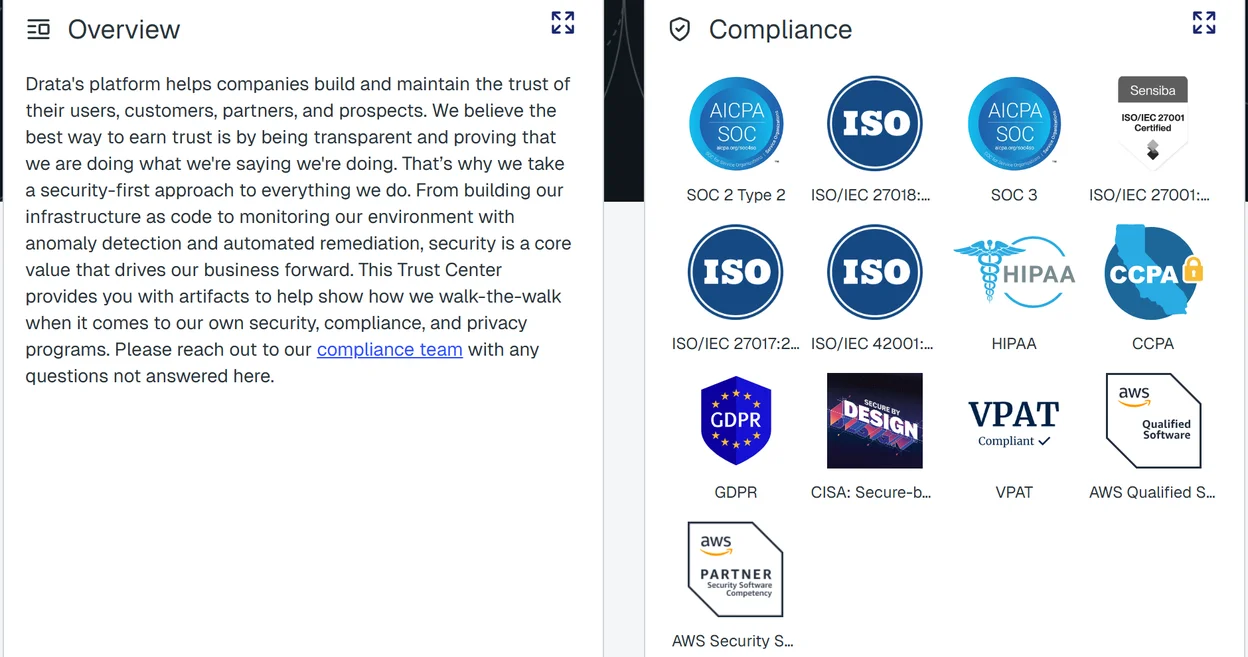
Drata says it ships more than 30 pre-built frameworks, from SOC 2 and ISO 27001 through NIST 800-53, FedRAMP, DORA and three AI standards: ISO 42001, NIST AI RMF and AIUC-1. FedRAMP and CMMC, the Cybersecurity Maturity Model Certification, run inside the general platform with no separate defense plan. That puts Drata in our CMMC compliance software ranking next to Secureframe, which sells a separate Defense plan.
Custom frameworks remain a paid add-on on both the Advanced and Enterprise GRC cards, not a free inclusion on the top plan. No-code custom tests, which Drata calls Adaptive Automation, are the feature that pulls customisation up to 4 out of 5 on our rubric.
Evidence collection and monitoring
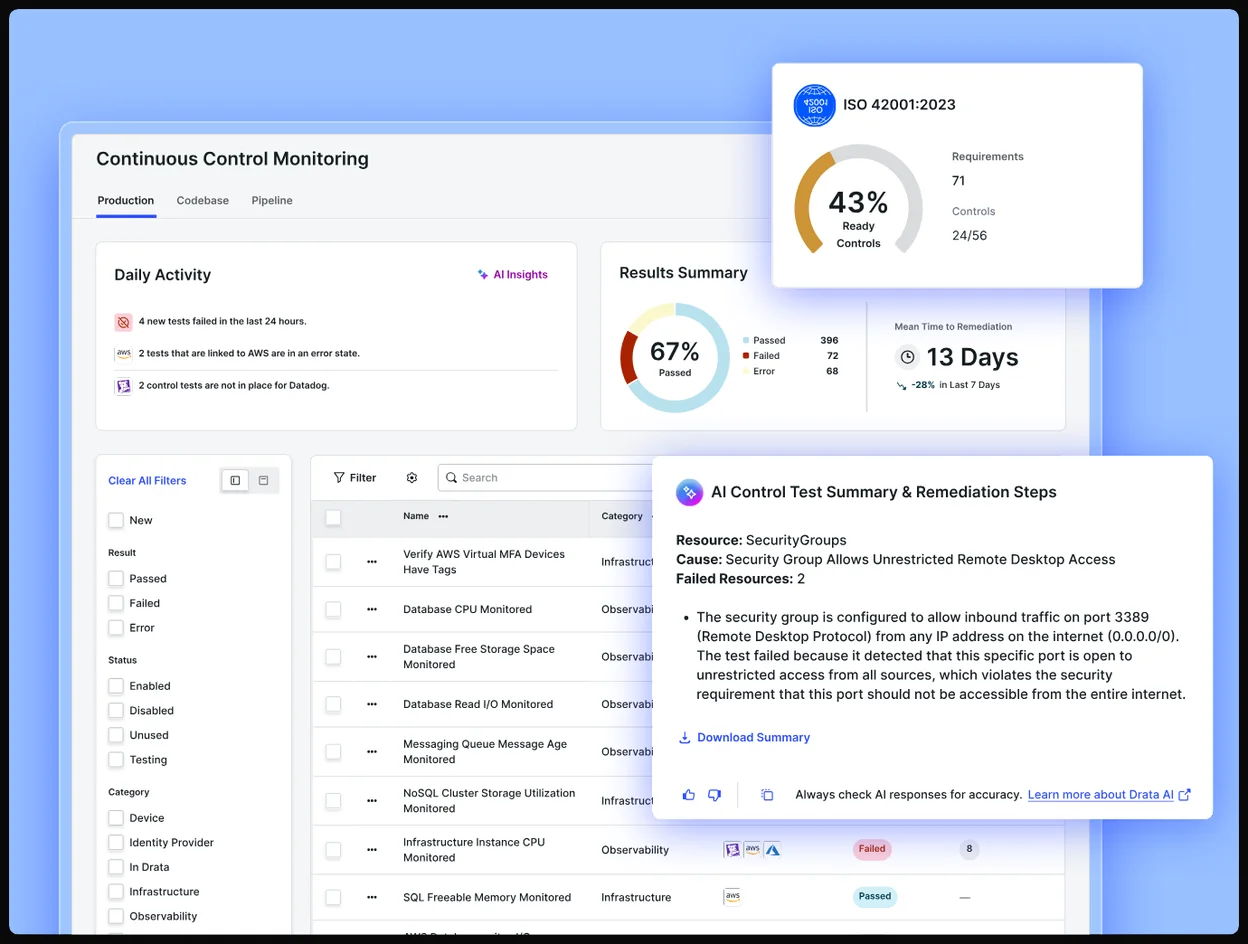
Drata gives no integration number, describing “hundreds of tools across your tech stack.” The rubric counts “hundreds” at its floor of 200, so Drata scores the 200-to-299 band, which with a public API and custom connections earns 4 out of 5 on automated evidence. One AWS Marketplace listing cites more than 200 applications.
Continuous tests run against connected tools and flag failures for remediation. Adaptive Automation extends that into no-code custom tests, the detail that separates Drata from a platform built only around its own library. Drata’s about page claims 15.7 million evidence items processed daily.
Audits
Drata’s Auditor Alliance is a named network of more than 175 audit firms, with A-LIGN, Coalfire and Armanino named as partners. Auditors work inside the platform through the Audit Hub, reviewing evidence and approvals in one workspace. Drata says more than 80% of its customers find their auditor this way.
That combination earns Drata 3 out of 5 on audit path. It falls short of a vendor that sells the audit itself as part of the deal. Thoropass does exactly that, through its own CPA firm, and scores a full 5 here. Whichever platform you pick, the SOC 2 report itself is signed by a licensed CPA firm.
Vendor risk
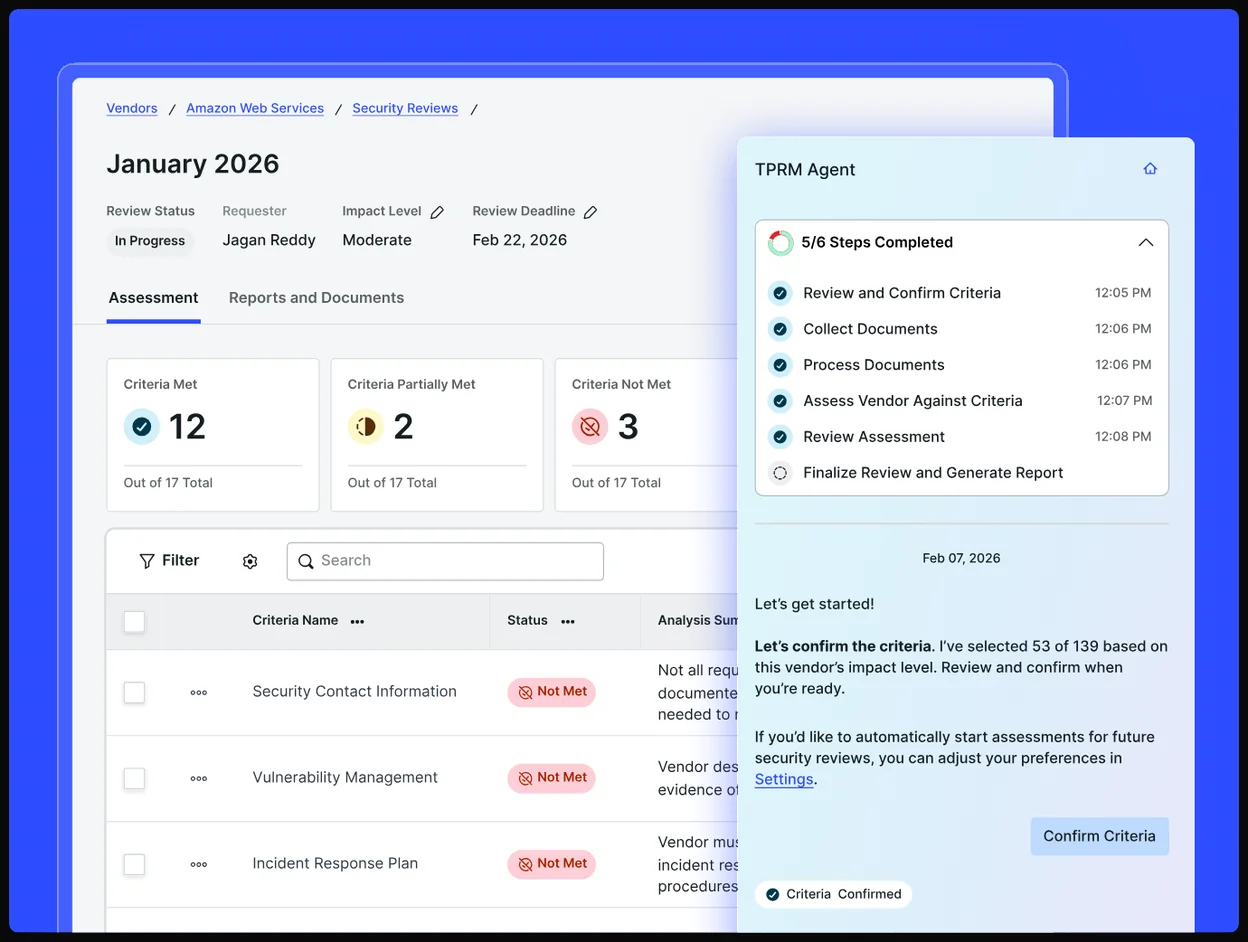
Vendor Risk Management sits inside the core platform, building a vendor directory that can pull from Okta SSO, then tracking risk ratings and questionnaires sent from Drata itself. A separate, newer product, Third-Party Risk Management, became generally available in September 2026 and is sold on its own, priced per assessment rather than per vendor. A customer can run a free inherent risk check across its vendors and pay only when one needs a full review.
Automated review of vendor security documents is what moves vendor risk up to 4 out of 5 on our rubric. Continuous monitoring of a vendor after onboarding would push it to a 5, the mark OneTrust, Vanta, Sprinto and Scrut earn. Drata lists recurring reviews and automated reassessment schedules, which the rubric does not count as continuous monitoring.
Trust center and security questionnaires
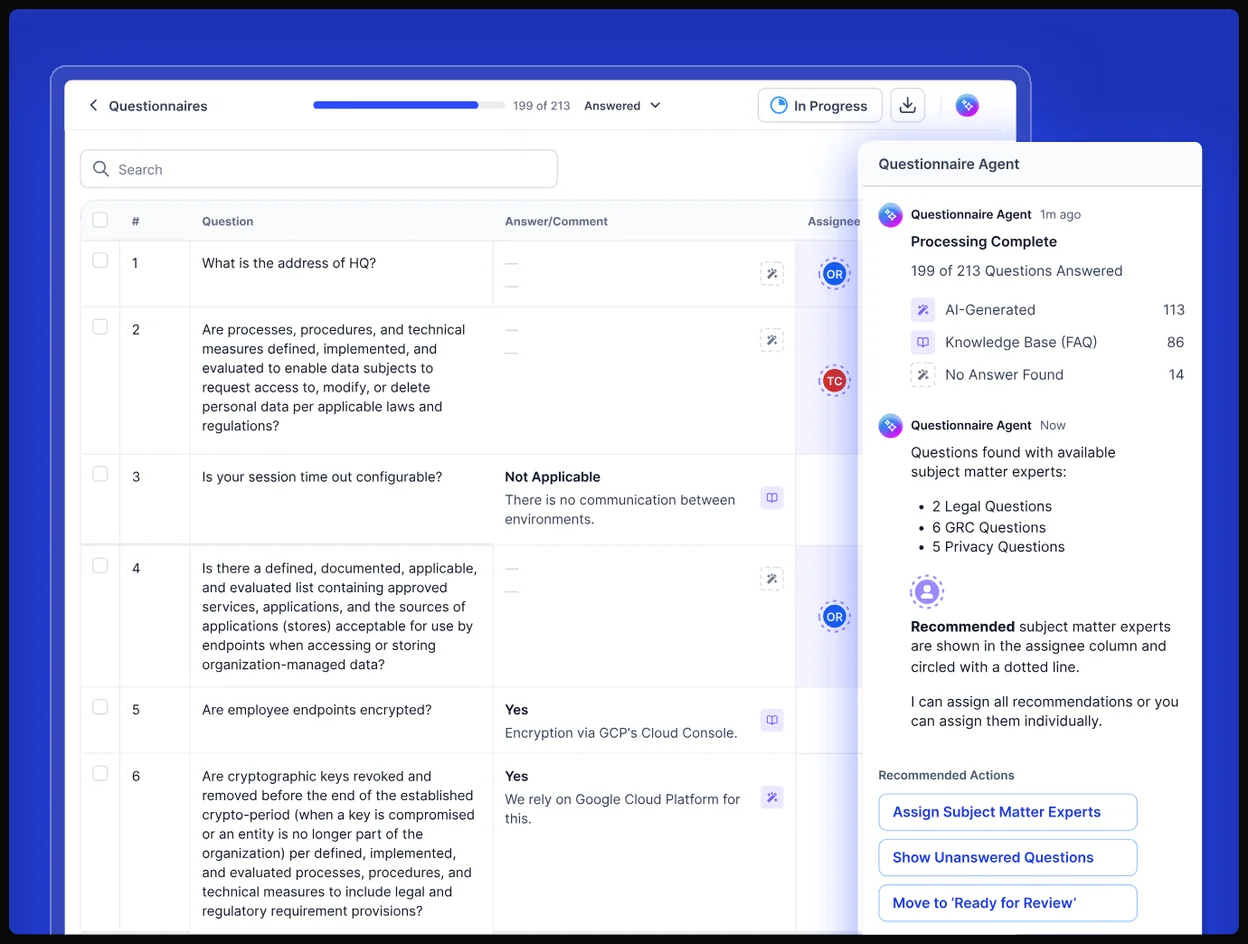
Drata’s Trust Center runs on the SafeBase platform it acquired, with a custom domain, a company’s own branding, and a count of approved domains that scales by plan, up to 100 on Foundation. Clickwrap NDA support can gate the more sensitive documents behind it.
AI Questionnaire Assistance drafts answers from the same Trust Center knowledge base a company’s subject experts keep current, then routes them for a human sign-off before anything ships. That combination of a trust center and AI-assisted questionnaire answering is worth 4 out of 5 on our rubric.
Policies and people
Policy templates come with the platform. Policies pulled in from Confluence or Notion sit in the same workflow as Drata’s own templates, with AI-suggested control mapping and multi-step approval chains.
Personnel come in through HR and identity-provider sync, with dedicated processes for onboarding and for offboarding when someone leaves. Background checks and security training run through named integration categories, Certn and Checkr for one, Coursera and Cornerstone for the other.
A native device agent, open source since 2023, reads workstation settings such as disk encryption and screen lock once a day, on a fixed schedule a customer cannot change.
Support and services
Support starts with an AI assistant called Dratanaut, which Drata says resolves more than 80% of requests on its own before a customer has to ask for a human. Coverage runs 24 hours a day, Monday through Friday. An in-house team of former auditors and compliance staff backs up both the chat and email channels, and onboarding is named as a standard part of every contract rather than a separate line item.
What G2 reviewers say
Drata holds 4.7 out of 5 from 1,397 reviews on G2. 84% of reviews are five stars and 13% are four stars.
Customer support tops the praise themes, ahead of ease of use and compliance coverage. Limited integrations lead the complaints, followed by bugs in the integrations that do exist, general room for improvement, unclear guidance and interface polish.
A mid-market reviewer titled a review “Drata’s Biggest Risk Is Its Support Team and When You Need Help, You’re On Your Own,” and Drata’s VP of Customer Experience replied in the thread.
Who should buy Drata
- Teams that will write a lot of their own tests. Adaptive Automation’s no-code builder and a 4-out-of-5 customisation score fit a program that outgrows the vendor’s built-in test library fast.
- Programs that need a named auditor relationship. The Auditor Alliance connects a company to more than 175 vetted firms, including A-LIGN, Coalfire and Armanino, with evidence review happening inside the Audit Hub.
- Companies juggling vendor risk alongside their own controls. Vendor Risk Management and the new standalone Third-Party Risk Management product both live under one roof, and vendor risk scores 4 out of 5 here.
Who should look elsewhere
- You want a price before the first call. Secureframe is the only vendor in this set with a starting list price, at $7,500 a year.
- You want the audit bought with the platform. Thoropass delivers the audit itself, through its own CPA firm, and scores a full 5 on audit path against Drata’s 3.
- Integration breadth matters more than anything else. Vanta claims more than 400 integrations, the largest catalog in the SOC 2 ranking, and outscores Drata 82 to 76.
- Customisation is the deciding factor. Sprinto scores a perfect 5 on customisation, a point ahead of Drata’s 4. Sprinto, at 84, is the top-scoring Drata alternative.
How we score it
Drata scores 76 out of 100 on rubric v0.9. Full marks go to framework coverage and user sentiment, the same two categories where most of this set clusters together. Pricing transparency is the lowest score at 1 out of 5, since Drata names plans without a single dollar figure. Audit path follows at 3 out of 5, credited for the Auditor Alliance network and in-platform evidence review, with no credit for selling the audit itself.
Score by criterion
- Framework coverage15% of total5/5
Drata covers all ten frameworks in the matrix.
Level 5: All of level 3, plus three or more of ISO 42001, NIST CSF, NIST 800-53, FedRAMP or CMMC.
- Automated evidence20% of total4/5
Drata describes its catalog as 'hundreds of tools' without a number. 'Hundreds' counts at its floor of 200, so the score uses the 200 to 299 band. A public API and custom connections are documented.
Level 4: 200 to 299 integrations, continuous tests, and a public API or custom integration builder.
- Audit path15% of total3/5
The Auditor Alliance, which Drata says counts more than 175 audit firms, including A-LIGN, Coalfire and Armanino. Auditors work on evidence inside the platform through the Audit Hub. No credit for buying the audit as part of the platform deal.
Level 3: Both a named partner network and auditor review of evidence inside the platform.
- Pricing transparency10% of total1/5
Plan names only: two tracks, GRC Platform and Assurance Platform, each with Foundation, Advanced and Enterprise plans. No dollar figures.
Level 1: Plan names and inclusions, with no numbers.
- Trust and questionnaires10% of total4/5
A trust center built on the SafeBase acquisition, plus AI questionnaire assistance.
Level 4: Both, with AI-assisted questionnaire answering.
- Vendor risk management10% of total4/5
Third-party risk management that pulls vendor trust center documents and runs assessments.
Level 4: All of level 3, plus automated review of vendor security documents.
- Customisation10% of total4/5
Custom frameworks (an add-on on the Advanced and Enterprise plans) and no-code custom tests.
Level 4: Custom frameworks, plus custom automated tests.
- User sentiment10% of total5/5
4.7 out of 5 from 1,397 reviews on G2.
Level 5: Average 4.5 or higher with 200 or more reviews.
Not credited in this score
- A integration count
Drata can ask for a re-check of any of these. If the score changes, the change is logged.