SOC 2 for Startups: When to Start, Which Report, What It Costs
Five scoped ranges, four from platform sellers, put a startup's first SOC 2 year at $20,000 to $110,000. Sources split on Type 1 first and give 3 to 12 months.

A startup needs SOC 2 when an enterprise or mid-market buyer asks for the report. Vanta says to consider it “when enterprise or mid-market deals enter your pipeline.” No law requires it, and BARR Advisory says SOC 2 “is not a mandatory legal compliance requirement for any organization.” On the first report, the sources disagree. Linford and Co, a CPA firm, recommends a Type I for first-timers. Vanta says go straight to a Type 2 unless a deal needs proof fast. Vanta puts a first Type 2 at four to six months with automation, and Scrut puts it at 6 to 12. Drata says “Most startups spend between $25,000 and $50,000” in year one, and Vanta says $20,000 to $80,000 or more. For a 15-engineer startup on the Security criterion alone, Thoropass says $40,000 to $100,000 for year one.
When customers start asking
Vanta says “Procurement teams at large companies may pause vendor onboarding until a SOC 2 report is on file.” Drata says “many customers require SOC 2 compliance from new vendors” and that a startup without one risks “significant delays in their sales cycle.” Both sell compliance software.
Workstreet, a compliance consultancy that implements Vanta, describes the buyer’s side. Enterprise InfoSec, legal and procurement teams send a “200-item security questionnaire,” and the question at the top is whether the vendor has a current SOC 2 Type 2 report. Workstreet lists a large deal, Series A Fundraising and handling sensitive data as the three triggers. Vanta calls investors “a secondary trigger” behind sales.
The AICPA defines SOC 2, and Linford and Co says the AICPA has issued no checklist and calls a readiness assessment “the next best thing.” Vanta says that waiting until a deal depends on the report means compressing “months of preparation into weeks.”
Type 1 first or straight to Type 2
A Type 1 report speaks to the design of controls on a single date, and a Type 2 report speaks to design and operation across a period. Four sources take a position.
| Source | Position | In its words |
|---|---|---|
| Linford and Co (CPA firm, article last updated 2023) | Type I first | “Generally, we recommend first-timers to start with a SOC 2 Type I report” |
| Vanta (platform seller) | Type 2, unless revenue is blocked | “Get a Type 2 report right away unless an immediate deal requires proof fast” |
| Workstreet (Vanta implementation partner) | Type 2 in most cases | “In most cases, we advise going directly for a SOC 2 Type 2 report” |
| Scrut (platform seller) | Type 2 once controls have run 3 months and evidence exists | “delaying with a Type I mostly costs you time” |
Linford’s reason is speed and flexibility on the assessment date. Vanta’s reason is cost: “a Type 1 first often means paying for two audits.” On Drata’s small to midsize ranges, a Type 1 audit runs $7,500 to $15,000 and a Type 2 audit runs $12,000 to $20,000, so two audits add to $19,500 to $35,000.
Scrut says “If a customer explicitly asks for Type II, a Type I will not satisfy their procurement requirement.” It also says a Type I is “genuinely useful when controls are newly implemented and have not yet been practiced.”
How long it takes
Each source gives a range, and the ranges overlap.
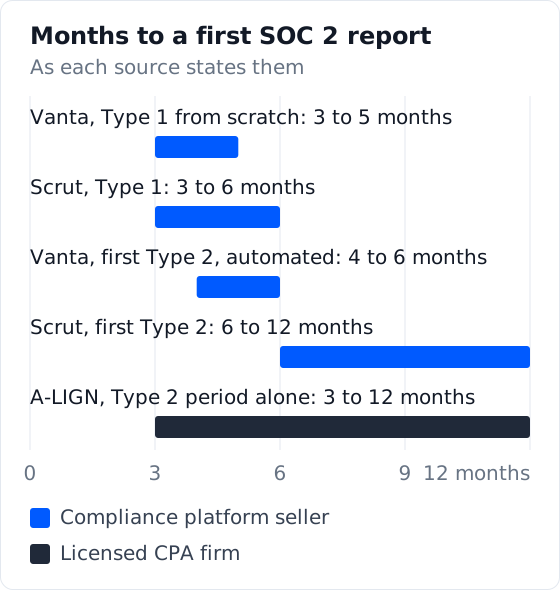
Months to a first SOC 2 report as each source states them. Vanta’s figure for a first Type 2 assumes automation.
Vanta says a Type 1 takes three to five months from scratch, or 10 to 12 weeks with basic controls in place. Scrut says most organizations reach a first Type I in 3 to 6 months. For a Type 2, Vanta says the observation window is “at least three months.” Scrut says the AICPA sets no formal minimum and that 3 months is “the practical floor.” A-LIGN, a licensed CPA firm, describes the Type 2 period as “typically a 3-to-12-month period.”
Scrut gives auditor fieldwork 2 to 5 weeks and report delivery 2 to 6 more weeks after the period ends. BARR Advisory says a report stays valid for a year from issuance.
What the first year costs
The five ranges below run from $20,000 to $110,000. Four come from platform sellers and one from TrustNet. Scope is as the seller defines it.
| Source | Scope | First-year total |
|---|---|---|
| Drata | Small startup | From $25,000, most between $25,000 and $50,000 |
| Vanta | Startup, lean Type 1 at the low end | $20,000 to $80,000 or more |
| Thoropass | 15-engineer SaaS company on AWS, Security criterion only, Type 2 with a short window | $40,000 to $100,000 |
| TrustNet | Company of up to 50 people | About $40,000 |
| Scrut | 50 to 100 people, three criteria, first Type 2, platform included | $50,000 to $110,000 |
The lines inside those totals differ by source. Thoropass lists readiness at $5,000 to $15,000, a platform at $3,000 to $10,000 and the auditor at $15,000 to $40,000. It adds 100 to 150 hours of staff time, priced at $15,000 to $30,000. Scrut lists a penetration test at $10,000 to $15,000 and mobile device management at $5,000 to $10,000, with staff time of $5,000 to $10,000 when a platform is in use. Drata notes that SOC 2 itself does not always call for a penetration test, though many customers demand one.
Linford and Co’s range for SOC 1 and SOC 2 audits at all company sizes is $20,000 to $150,000, and its median is about $30,000. TrustNet’s benchmark is $7,500 to $35,000 for a Type 1 and $15,000 to $60,000+ for a Type 2.
Startup plans and what platforms publish
The pricing study lists the starting prices below. Only secureframe.com prints a price. The pricing pages for Vanta, Drata and Sprinto list plan names and route to a demo or quote request. The rubric gives 1 for published plan names and inclusions with no numbers, and 2 for a single published starting price. Secureframe earns 2 of 5, Sprinto, Vanta and Drata earn 1, and Scrut and Thoropass earn 0.
| Platform (rubric total) | Covers | Plan | Starting price | Where |
|---|---|---|---|---|
| Sprinto (84) | Up to 100 employees | Starter Platform | $7,500 a year, then a first framework from $2,000 | AWS Marketplace |
| Vanta (82) | 1 to 20 employees | Essentials | $14,000 a year | AWS Marketplace |
| Drata (76) | 1 to 50 employees | Foundation Package | $15,000 a year | AWS Marketplace |
| Secureframe (75) | Up to 100 employees | Fundamentals | $7,500 a year | secureframe.com |
| Scrut (72) | Up to 20 employees | Compliance Automation | $15,000 a year | AWS Marketplace |
| Thoropass (52) | No band stated | Platform Subscription | $8,700 a year, first framework included | AWS Marketplace |
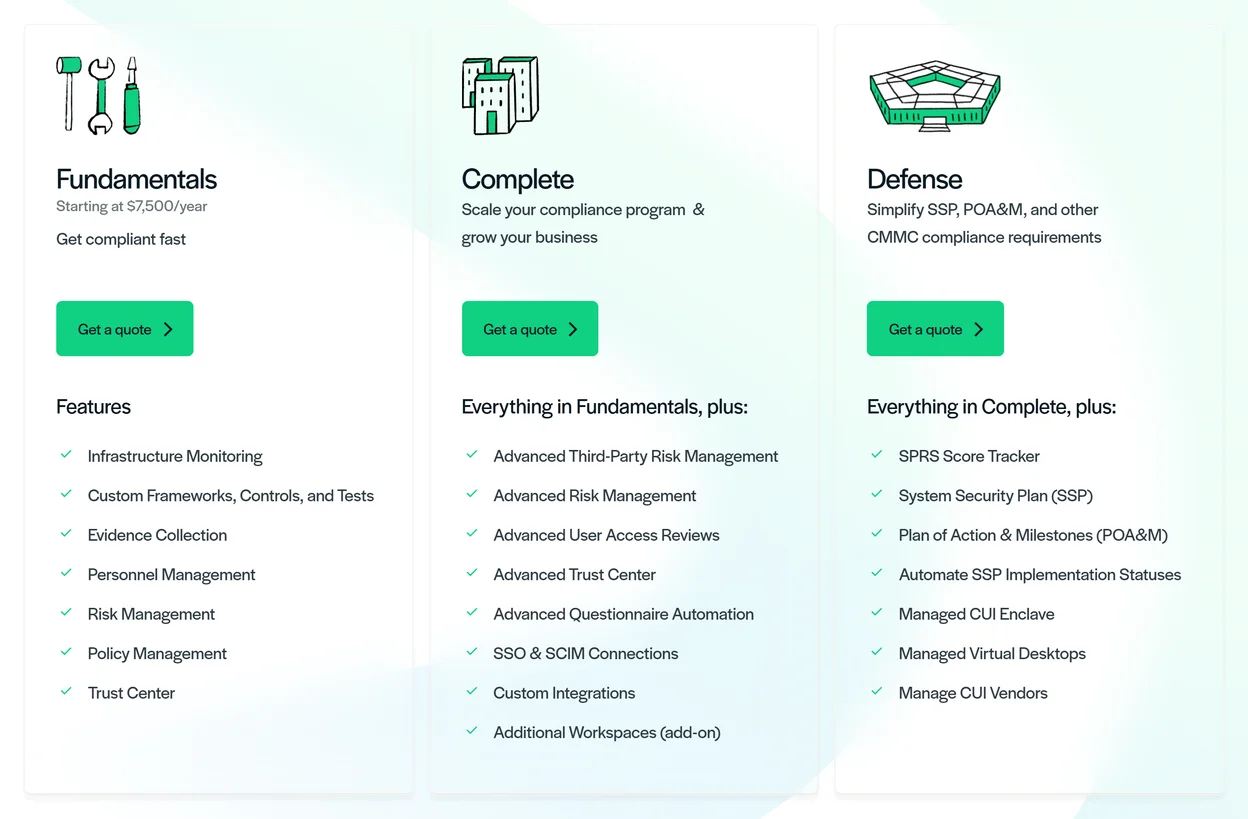
Secureframe’s plan cards.

Sprinto describes its Foundation plan as “For startups on their first certification.” Vanta describes Essentials as “for companies who want to stay focused on building.” On the six-platform ranking, the rubric totals are Sprinto 84, Vanta 82, Drata 76, Secureframe 75, Scrut 72 and Thoropass 52.
Startup programs publish fewer figures than the price lists. Vanta says startup-specific pricing is available on request and offers a trial of “typically five to seven days.” HubSpot’s offer page gives HubSpot for Startups members 25% off Vanta as a new customer. Drata’s investor-partner page promises “A preferred discount or offer for qualifying portfolio companies” with no percentage. Thoropass runs a startup program for venture firms and accelerators with “flexible pricing.” A bundle from Thoropass, CITSAP and DuploCloud called SOC 2 Accelerator for Startups is sold by CITSAP on AWS Marketplace through private offers.
The audit: bundled or separate
Compliance software does not perform a SOC 2 audit. A licensed CPA firm tests the controls and signs the report. Thoropass delivers the audit through Thoropass Assurance, which Thoropass describes as a licensed CPA firm. On AWS Marketplace, Thoropass lists the platform from $8,700 a year and the SOC 2 audit from $5,800 a year, so the two start at $14,500 together.
Vanta says its partner network connects customers with AICPA peer-reviewed auditors and that “The audit is a separate engagement.” Drata names more than 175 audit firms in its Auditor Alliance. Secureframe runs an Audit Partner Network. Sprinto’s pricing page lists access to its auditor network, and Scrut offers an Audit Center for auditor evidence review.
Linford and Co cautions that a platform vendor’s partner auditor with “a set audit fee that is extremely low compared to other bids in the market” has produced results that were “too good to be true.”
What a startup can skip or defer
Security is the only mandatory category. Vanta says “Most startups scope their first audit to Security alone (plus criteria their customer contracts require).” A-LIGN ties the other four to the customer:
- Availability when customers worry about downtime and service level agreements.
- Confidentiality when the company stores information covered by non-disclosure agreements.
- Processing Integrity when customers run critical operations on the system.
- Privacy when customers store personal information in it.
Each added criterion raises the bill. Sensiba puts the extra cost of Availability or Confidentiality at roughly 10% to 20% each, and of Processing Integrity or Privacy at roughly 20% to 50% each. Thoropass says 15% to 30% per added criterion.
Scope can also stay narrow in systems. BARR Advisory says “You don’t need to include every system in your scope.” Schellman calls carve-outs, which leave a third party’s controls out of testing, “by far the most common approach.”
A readiness assessment can run internally. Thoropass puts it at $0 when done in-house and as much as $25,000 with a consultant.
The audit by a CPA firm cannot be skipped, and neither can the observation window for a Type 2.
Platforms in this article





Frequently asked questions
-
Does a startup need SOC 2?
No law requires it. BARR Advisory says SOC 2 "is not a mandatory legal compliance requirement for any organization." Vanta says a startup should consider it when enterprise or mid-market deals enter the pipeline, because procurement teams at large companies may pause vendor onboarding until a SOC 2 report is on file.
-
Should a startup get SOC 2 Type 1 or Type 2 first?
The sources disagree. Linford and Co, a CPA firm, recommends first-timers start with a Type I. Vanta says to go straight to a Type 2 unless an immediate deal needs proof fast. Scrut says a Type I will not satisfy a customer who explicitly asks for a Type II.
-
How long does SOC 2 take for a startup?
Vanta puts a Type 1 at three to five months from scratch and a first Type 2 at four to six months with automation. Scrut puts a Type 1 at 3 to 6 months and a Type 2 at 6 to 12. A-LIGN says a Type 2 observation period is typically 3 to 12 months.
-
How much does SOC 2 cost for a startup?
Vanta says startups should budget $20,000 to $80,000 or more all-in for the first year. Drata says most startups spend between $25,000 and $50,000. For 15 engineers on the Security criterion alone, Thoropass says $40,000 to $100,000 in year one.
-
Which parts of SOC 2 can a startup skip?
Security is the only mandatory category. Vanta says most startups scope the first audit to Security alone, plus any criteria their customer contracts require. BARR Advisory says a company does not need to include every system in scope.