SOC 2 Penetration Test Cost: Published Prices by Test Type
Blaze Infosec's range for a standard SaaS SOC 2 pen test is $8,000 to $25,000. Invadel publishes $5,200 for a small web app and $4,200 for an external network.

Blaze Infosec’s range for a standard SaaS scope is $8,000 to $25,000. Synack puts a combined web and network test for a small or mid-sized business at $10,000 to $25,000. Drata puts the pen test line in a SOC 2 budget at $5,000 to $15,000. Scrut puts it at $10,000 to $15,000 for two products in a 50 to 100 person build with a platform. Blaze and Synack sell tests, and Drata and Scrut sell compliance platforms. Invadel sells tests and publishes fixed starting prices of $5,200 for a small web application and $4,200 for a small external network.
Linford and Co, a CPA firm, says SOC 2 does not require a penetration test, and a CC4.1 point of focus names penetration testing as an example of a separate evaluation. Sellers differ: BreachLock’s SOC 2 page says both that a pen test is not required and that SOC 2 includes a requirement for regular penetration testing. Drata says customers may look for and expect one, and Blaze says auditors often do. The price moves with the number of applications, user roles, API endpoints and IP addresses in scope.
Penetration test cost by test type
Blaze Infosec and VikingCloud publish typical ranges by test type. Invadel publishes fixed starting prices for small, medium and large scopes, and the table shows all three.
| Test type | Blaze Infosec | VikingCloud | Invadel small, medium, large |
|---|---|---|---|
| Web application | $5,000 to $30,000 | $5,000 to $30,000 | $5,200, $7,800, $12,500+ |
| API | $5,000 to $20,000 | $5,000 to $20,000 | $4,000, $6,000, $9,500+ |
| External network | $5,000 to $20,000 | $5,000 to $20,000 (internal and/or external) | $4,200, $6,800, $8,400 |
| Internal network | $7,000 to $35,000 | Covered in the network row | $6,000, $9,200, $14,500+ |
| Cloud | $10,000 to $40,000+ | $10,000 to $40,000 | $6,800, $10,500, $17,500+ |
| Mobile app | $5,000 to $30,000 | $12,500 to $40,000 | $6,000, $8,500, $14,000+ (iOS and Android) |
Invadel defines small as a single focused target such as one app or one API. Medium is a multi-component environment, and large is several integrated systems tested together. Blaze says a typical web application test takes 1 to 3 weeks and an API test 1 to 2 weeks.
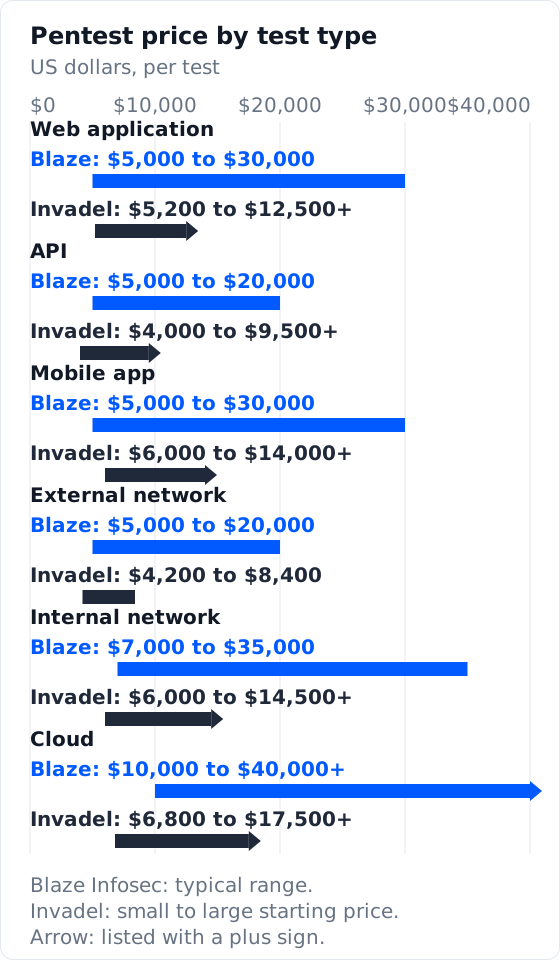
Blaze Infosec’s typical range against Invadel’s small-to-large starting prices. An arrow means the seller lists the price with a plus sign.
Blaze splits web application tests by app size. A simple SaaS app runs $4,999 to $8,999 over 3 to 7 testing days. A medium app with several roles, APIs and business logic runs $8,999 to $20,000. A complex multi-tenant app with SSO and payment flows runs $20,000 to $30,000 or more. Invadel’s three web application prices are $5,200, $7,800 and $12,500 or more. Blaze gives a typical range for the whole test type, and Invadel gives a starting price for each size.
What a SOC 2 scope costs
Published figures cover different scopes, so compare the scope column before the price.
| Source | Scope as published | Published price |
|---|---|---|
| Blaze Infosec | Standard SaaS scope for SOC 2 | $8,000 to $25,000 |
| Blaze Infosec | SOC 2 test limited to a web app, API or SaaS product | From $4,999 |
| Synack | Web app plus API, gray box, startup or Series A to B | $15,000 to $35,000 |
| Synack | Combined web and network test, small or mid-sized business | $10,000 to $25,000 |
| Bright Defense | Three fixed plans: 1 web and 1 API endpoint, 3 web and 1 API, 6 web and 3 API | $2,750, $5,250 and $9,250 |
| Drata | Annual pen test line in a SOC 2 budget | $5,000 to $15,000 |
| Scrut | Two products, external and application level, 50 to 100 employees, with a platform | $10,000 to $15,000 |
| Scrut | Same build without a platform | $10,000 to $20,000 |
Scrut says a real quote for a mid-size company with two products came in at $14,000. It adds that two products produce four test reports, because testing runs at the infrastructure level and the application level. Bright Defense’s three plans differ in testing hours as well as scope, at 48, 96 and 176 hours.
Scrut itemizes the pen test at $10,000 to $15,000 inside a $50,000 to $110,000 first-year SOC 2 cost build. Thoropass’s $40,000 to $100,000 build for a 15-engineer company has no pen test line. Drata puts a gap assessment at $5,000 to $25,000 beside the $5,000 to $15,000 pen test.
Is a penetration test required for SOC 2
Linford and Co, a CPA firm, answers no: “the simple answer is no. Is it a good idea? Absolutely.” Linford quotes the CC4.1 point of focus, which lists penetration testing as one example of an evaluation: “Management uses a variety of different types of ongoing and separate evaluations, including penetration testing, independent certification made against established specifications (for example, ISO certifications), and internal audit assessments.”
CC4.1 itself asks management to select and perform evaluations that show whether internal controls are present and functioning. A pen test is one way to do that. The CC7.1 point of focus covers vulnerability scans, which Blaze says support CC7.1 and are not required.
Drata says customers and prospects may look for and expect a pen test when they evaluate a SOC 2 report. Drata adds that auditors will likely scrutinize the decision-making process when a company skips one. Blaze says auditors often expect evidence that a company tests its controls, and that a test of only a marketing website gives an auditor little evidence. Blaze also says the auditor should not design the test.
SOC 2 audits are performed by a licensed CPA firm, and Blaze advises confirming the test scope with that auditor before finalizing it.
PCI DSS and ISO 27001
Strike, a pentest firm, quotes PCI SSC text that requires penetration testing under PCI DSS v4.0.1 Requirement 11.4. The text asks for external and internal testing “At least once every 12 months” and “After any significant infrastructure or application upgrade or change.” A qualified internal resource or a qualified external third party can run it, and the tester does not have to be a QSA or ASV. The requirement says testing is “repeated to verify the corrections.” Under 11.4.6, service providers test segmentation controls at least every six months.
Linford says the frequency and scope of a pen test for SOC 2 should come from a risk assessment. ISMS.online, a compliance software vendor, lists penetration tests in its guidance for ISO 27001 Annex A control 8.29, security testing in development and acceptance.
What moves the price
- Applications, roles and endpoints. Blaze lists the number of applications, features, user roles, API endpoints, authentication flows, file upload areas, payment workflows and third-party integrations.
- Products. Scrut counts two products as four reports, because testing runs at the infrastructure and application levels.
- IP addresses. Synack says an external test of fewer than 20 IPs might cost $4,000 to $6,000. Blaze puts a small perimeter with limited public IPs and services at $5,000 to $10,000.
- Hourly rates. Blaze says providers commonly charge $250 to $300 an hour. Synack says specialist rates run $150 to $400 an hour and senior boutique day rates $1,200 to $3,000.
- Manual or autonomous testing. Astra’s Pentest Auto, an autonomous plan, is $2,999 a year for one target. Its Pentest Expert plan, with certified pentesters, is $5,999 a year. SecurityMetrics says a test under $4,000 likely is not a genuine pentest, and soc2auditors.org, an ad-supported directory, says an auditor may not accept an autonomous-only test. Intruder says it refunds a test in full if an auditor rejects the report.
- Scope of the SOC 2 system. Blaze says auditors check whether the tested systems match the SOC 2 system boundary.
Retests
Blaze offers one round of fix validation within 90 days at no charge in most engagements. Invadel includes a free retest of remediated findings in every test, except phishing campaigns. Bright Defense says retest support is included in its plans. SecurityMetrics says some testers include retesting in the price and others provide results and leave. VikingCloud lists a retest or rescan as a possible additional cost. Synack gives the example of a $10,000 engagement that charges $3,000 per retest. Astra’s Pentest Auto includes one human re-scan and Pentest Expert includes two.
Pentest as a service
Pentest as a service sells testing on a subscription or per-test basis. Prices below come from the sellers.
- Astra: Pentest Auto at $2,999 a year, Pentest Expert at $5,999 a year, each for 1 target. One web or SaaS app counts as one target with its APIs, mobile is priced per platform, and each network, cloud account, IP set or standalone API is one target. Enterprise starts at $9,999 a year.
- Intruder: $3,500 per white-box web application test with unlimited retesting, or $12,000 for a pack of 4 tests used within a year.
- Cobalt: $3,500 per autonomous web application test, a promotional price for tests started and finished before December 31, 2026. Cobalt also sells credits worth 8 hours of testing each in annual packages.
- Synack: $20,000 to $100,000 or more a year for annual PTaaS programs.
What the compliance platforms offer
The rubric has eight criteria, and none scores a pentest offer, so these offers leave every score unchanged. Sprinto scores 84, Vanta 82, Drata 76, Secureframe 75, Scrut 72 and Thoropass 52 among the ranked SOC 2 platforms.
Vanta lists penetration testing partners in its partner directory, and one entry, from 13 Security, offers up to 50% off its services for Vanta customers.

Drata lists a BreachLock offer of 20% off penetration testing in its service partner directory.

Sprinto and Astra announced a partnership on January 9, 2026 that connects Astra’s pentest findings to Sprinto’s compliance workflow. The announcement carries no price.
Scrut says it is CREST-accredited for penetration testing. It says its platform can cover infrastructure-level testing and that application-level testing still needs a third-party vendor.
Thoropass lists penetration testing as a service line and describes its testers as CREST-accredited. Its pentest page publishes no price.

A percentage is a discount on a seller’s quote and gives no dollar figure. Platform subscriptions are priced separately: Sprinto’s AWS Marketplace listing starts at $7,500 a year for up to 100 employees, plus a first framework from $2,000, as the compliance software pricing study records.
Platforms in this article



Frequently asked questions
-
How much does a penetration test cost?
Blaze Infosec puts a standard commercial engagement at $10,000 to $35,000. SecurityMetrics says $5,000 to $15,000, and over $30,000 for complex environments. VikingCloud says $5,000 to $30,000, and Synack says $5,000 to $100,000 or more with $10,000 to $30,000 typical. The price depends on the test type, the number of applications, roles and IP addresses, and whether a retest is included.
-
How much does a SOC 2 penetration test cost?
Blaze Infosec puts a standard SaaS scope at $8,000 to $25,000, and a focused web app, API or SaaS test from $4,999. Drata puts the line at $5,000 to $15,000. Scrut puts two products tested externally and at the application level at $10,000 to $15,000 with a platform. Bright Defense publishes three fixed plans at $2,750, $5,250 and $9,250.
-
Is a penetration test required for SOC 2?
Linford and Co, a CPA firm, says the answer is no, and a CC4.1 point of focus names penetration testing as an example of a separate evaluation. BreachLock, a pentest seller, says both that it is not required and that SOC 2 includes a requirement for regular testing. Drata says customers may look for and expect one, and Blaze Infosec says auditors often do.
-
How much does a web application penetration test cost?
Blaze Infosec puts a web application test at $5,000 to $30,000, from $4,999 for a simple SaaS app to $20,000 to $30,000 or more for a complex multi-tenant app. VikingCloud says $5,000 to $30,000. Invadel publishes $5,200 for a small web app, $7,800 for a medium one and $12,500 or more for a large one.
-
Does a penetration test price include a retest?
Blaze Infosec offers one round of fix validation within 90 days at no charge in most engagements. Invadel includes a free retest of remediated findings in every test except phishing campaigns. SecurityMetrics says some testers include retesting and others do not, and VikingCloud lists a retest or rescan as a possible additional cost.
-
How often is a penetration test required?
Strike, a pentest firm, quotes PCI SSC text for PCI DSS v4.0.1 Requirement 11.4 that asks for external and internal tests at least once every 12 months and after any significant change. Linford and Co says the frequency and scope of a pen test for SOC 2 should come from a risk assessment.